Hey up/rooted friends!
Just wanted to let you know that the Faith & Politics Immigration Forum that we co-sponsored went very well this past Monday. About 40 of us gathered at St. Mark's Lutheran Church in Aurora for a panel discussion on "Christian Responses to the Immigration Crisis". The panel consisted of Reverend Wayne Miller of St. Marks, Reverend Roy Brown of Progressive Baptist in Aurora (a predominantly African American congregation), and Father David Engbarth of Our Lady of Good Counsel Catholic Church in Aurora. I functioned as moderator for the discussion (and also represented both up/rooted and my own faith community, Via Christus in Yorkville). We gave the panelists about 45 minutes to respond to a few opening questions about the immigration issue and then opened it up for questions or comments from the audience.
I began by asking the panelists to describe their church and how immigration directly affects them. Father Engbarth probably had the most direct exposure of the three, as a large majority of his church was Hispanic. He gets to hear first hand accounts of immigrant life, and understands their struggles. He asked us to realize that at its core the immigration issue is very simple - it's literally a matter of survival. These people are not coming here because they want to. They are coming because they have no other choice for the survival of their families. They are economic refugees.
Rev. Brown said that his congregation, as African Americans, were dealing with having to share their power and status with a new minority group. I was especially interested in what he said about how the Hispanic community, by allowing themselves to be exploited and mistreated over here (often because undocumented immigrants have no ability to fight back), is actually undermining a lot of the civil rights that the black community has fought so hard for over the past 50 years. For instance, blacks have fought hard for fair wages and discrimination free work environments; but if Hispanic immigrants are willing to work for sub-standard pay and allow themselves to be mistreated by their employers, then that essentially undoes a lot of what blacks have worked towards.
Rev. Miller, representing a mostly white, middle-class congregation said that there is a difficulty in getting his people to see this as a justice issue (in the sense of respecting the human dignity of immigrants) rather than just a compassion issue (i.e. just giving poor immigrants a handout while still thinking of them as unwanted guests). He said his church was far more eager to get involved in ministries of compassion than ministries of justice.
The discussion quickly moved into the economic realities that are the underlying cause of immigration, both legal and illegal. Father Engbarth encouraged us to consider why these immigrants are coming here in the first place? What is it about our international, economic, political, and social systems that causes this situation? What is it that creates what are essentially "expendable human beings" (which is how many immigrants tend to feel about themselves because of how our society treats them, according to Father Engbarth). He suggested that the solution to immigration was not simply to seal our borders, but to focus on fighting global poverty and the systems that contribute to it.
In a similar vein, Rev. Miller said the key question was "Who is being served by our current immigration policy?" And the answer is that wealthy corporations and wealthy Americans in general are the ones currently benefitting from cheap, easily exploitable immigrant labor. He asked why we aren't doing something to dry up the demand for immigrants as much as trying to stem the supply.
Rev. Brown pointed out that stealing cheap labor from Mexico is not compassion, and suggested that while we should not deport immigrants already living here, we should seal our borders so as to protect immigrants from further exploitation.
When we opened it up for questions from the audience, discussion turned to how we can help undocumented immigrants become legal and help them "assimilate" without being patronizing or assuming they need to fit into the mold of white, middle-class American culture. We also talked some about the political and economic situation in Mexico that was causing so much immigration, and pointed out how free trade agreeements like NAFTA have exacerbated the problems greatly (though a lot of the blame also falls on the deep-seated and long-standing corruption in the Mexican government).
At this point we heard some first-hand testimony from a Mexican immigrant in the audience who shared with us his motivations for coming (his concern for the welfare of his family), his appreciation for America, and yet also his desire to return to Mexico someday. (One of the more interesting points made this evening was that most immigrants dream of going home someday to their native lands. They don't want to stay here in America forever. However, for most of them, that dream is eventually crushed and they resign themselves to staying in America.)
We closed the evening by asking how we could continue conversations like this, and how we could put these concerns into practical action. It was suggested that churches need to lead the way both politically, by advocating on behalf of the poor and the foreigners, and in creating practical processes by which we can help undocumented immigrants go through the steps they need to become legal. It was also said that churches simply need to be deliberate about integrating races and cultures, and do whatever they can to get different groups talking.
Overall we all felt like the night was a great success and we were eager to sponsor more forums like this in the future - perhaps spreading the net wider and involving more churches in the future. John Laesch, the Democratic candidate for Congress out here in my district, was there (we invited him and his opponent, House Speaker Dennis Hastert, though Hastert wasn't able to attend), and he suggested that eventually we should think about hosting a really big, area-wide event with speakers like Jim Wallis and others. It'd be really exciting to see if we could make this a regular thing and work up to that over the new few years. If we do, you can be sure I'll let you all know.
Speaking of future events, our next up/rooted gathering will be Monday, November 13 from 7-9pm at Kristine Socall's home in Winfield with a discussion on alternative forms of church, intentional communities, and radical discipleship. It should be great!
See you there,
-Mike Clawson
up/rooted co-coordinator
Wednesday, October 25, 2006


Thursday, October 19, 2006
Evangelicals for Darfur

"And the king will answer them, 'Truly I tell you, just as you did it to one of the least of these who are members of my family, you did it to me.'" - Matthew 25:40Evangelical Christians are uniting in an urgent effort to bring an immediate end to the genocide in Darfur.
In recent weeks, evangelical leaders have discovered profound unity on this crisis. Believing that God was calling them to act, a number of those leaders began talking about how evangelical Christians could respond together to this call. Those conversations led to the creation of Evangelicals for Darfur, a campaign that brings together media, web, and grassroots advocacy to call for an end to the senseless suffering in Darfur.
A broad and diverse group of evangelical leaders were eager to participate in this project. The leaders signed onto ads that are currently running in the nation's major newspapers calling on our nation's political leaders to boldly lead the effort to stop the suffering. I saw the ad in today's edition of the Chicago Tribune. The names at the bottom of the ad included:
- Rev. Rob Bell, Founding Pastor, Mars Hill Bible Church, author of Velvet Elvis
- Bishop Charles Blake, Pastor, West Angeles Church of God in Christ, Founder, Save Africa's Children
- Dr. Tony Campolo, Baptist evangelist and international speaker
- Rev. Rich Cizik, Vice-president for Government Affairs, National Association of Evangelicals
- Rev. Luis Cortés, Jr., President, Esperanza USA
- Rev. Wes Granberg-Michaelson, General Secretary, Reformed Church in America.
- Rev. Ted Haggard, President, National Association of Evangelicals
- Rev. Dr. Roberta Hestenes, Pastor, Community Presbyterian Church, Former President, Eastern University
- Dr. Joel Hunter, President, Christian Coalition of America
- Rev. Bill Hybels, Pastor, Willow Creek Church, leader of Willow Creek Association
- Bishop Harry Jackson, President, High Impact Leadership Coalition
- Dr. Richard Land, President, Southern Baptist Convention’s Ethics & Religious Liberty Commission
- Rev. Brian McLaren, author, leader in emerging church
- David Neff, Editor & Vice President, Christianity Today
- Dr. Glenn R. Palmberg, President, Evangelical Covenant Church
- Dr. Bob Roberts, Jr., Founding Pastor, NorthWood Church & founder of the Glocalnet network of churches
- Rev. Samuel Rodriguez, Jr., President, National Hispanic Christian Leadership Conference
- Rev. Dr. William J. Shaw, President, National Baptist Convention, USA
- Dr. Ron Sider, Founder and President, Evangelicals for Social Action
- Rev. Geoff Tunnicliffe, International Director, World Evangelical Alliance
- Rev. Jim Wallis, President, Sojourners/Call to Renewal, author of God's Politics
- Rev. Gloria E. White-Hammond, MD, Co-Founder, My Sister's Keeper
- Dr. Barbara Williams-Skinner, President, Skinner Leadership Institute
- Lauren Winner, author, and Visiting Lecturer, Duke Divinity School
The ad read as follows:
Without you, Mr. President,
Darfur doesn't have a prayer.We come to you from across the evangelical spectrum. We beseech you to act on your faith and do the right thing by leading the world to stop the genocide affecting "the least of these" in Darfur. To date, more than 400,000 people have been killed. 2.5 million displaced. Countless more have been raped, maimed, and tortured: Men, women, and children created in God's image, innocents all. Ending the atrocities will require your personal leadership in supporting the deployment of a strong U.N. peacekeeping force and multilateral economic sanctions. While we often disagree on matters of politics, we are united in the belief that your intervention can make the critical difference in Darfur. We join together now to urge you, in the words of Proverbs 24:11-12, to "rescue those being led away to death." We pledge to do everything we can to rally support in both Congress and the U.N. to uphold your efforts in bringing the horror in Darfu to an end.
If you want to add your name to the statement visit www.evangelicalsfordarfur.org. I am deeply encouraged by the broad spectrum of Christians who are speaking out together on this issue. Many of the names on this list are leaders whom I deeply respect. This is a cause that all of us should be able to get behind, regardless of denomination, theology, or political camp. For in matters of life and death, there is no left or right, there is only right and wrong. Together we can help make a life-saving difference for our brothers and sisters in Darfur.
Saturday, October 14, 2006
up/rooted Immigration Forum
This month up/rooted will be joining in an open forum panel discussion on "Christian Responses to the Immigration Crisis". The panel will consist of several clergy from the Fox Valley area (including myself) and we will discuss questions like:
The forum will be held on Monday, October 23 at 7pm at St. Mark's Lutheran Church in Aurora (27 S. Edgelawn Dr).
See you there!
Mike Clawson
up/rooted co-coordinator
- How does/should a Christian/biblical worldview influence your approach to the issue of immigration?
- Is there any tension between your Christian ethical response and your political sensibilities?
- What is your church currently doing to respond to the immigration crisis?
The forum will be held on Monday, October 23 at 7pm at St. Mark's Lutheran Church in Aurora (27 S. Edgelawn Dr).
See you there!
Mike Clawson
up/rooted co-coordinator
Saturday, October 07, 2006
What is the Emerging Church?
Someone I recently met online asked me to explain to them what the emerging church is and where it came from. Here was my reply which I originally posted at my blog and thought might be valuable to you all here as well:
You asked what the emerging church is and where it came from. Let's see... it started in the mid-nineties with a handful of evangelical pastors and authors who started noticing a shift in our culture and began asking themselves how the church needed to change and adapt to remain relevant to this new culture. Initially the conversation revolved around "generational" differences, in other words, how to reach out the Gen Xers. But it soon became apparent that the shift was broader than just young people. Our entire culture (for the most part) had transitioned from a Modern to a Postmodern world over the past 40 years or so; so church leaders began asking themselves what church in a postmodern context would look like. Over the next decade three overlapping streams of the conversation gradually emerged.
One stream, labeled by Ed Stetzer as "Relevants", have focused on worship styles and ways of "doing church". It was assumed that to reach postmoderns we would have to make church "cool" (e.g. coffee, candles, fine art, hip music, ancient liturgical elements, etc.) However, the point wasn't to be "trendy" so much as it was the missionary impulse to contextualize the gospel and worship to the local culture - in this case, early 21st century postmodern culture. I think it's mostly a good impulse. Granted, it can get a little faddish and formulaic at times, but on the other hand, I think we should be able to embrace experimentation and diversity in the ways we worship God, and to change our old habits and traditions in order to more effectively reach non-churched people. The key influencer in this stream has been Dan Kimball of Vintage Faith Church in Santa Cruz, CA with his books The Emerging Church and Emerging Worship.
Another stream, which Stetzer calls "Reconstructionists" has been more concerned with the structures and methods of church as a whole, not just with what we do in worship. There has been a lot of talk about the problems with big, institutional mega-churches and how they can become all about the show and the systems without encouraging authentic Christian community or spiritual transformation among its members. The reaction to this brand of contemporary Christianity has led many to look for smaller, more intimate expressions of church: house churches, cell churches, incarnational communities among the poor, etc. Reconstructionists have rejected the business-like models of church structure and leadership that have dominated both contemporary megachurches, as well as the older, more traditional churches, in favor of more collaborative, horizontal models. Some of these folks can be very anti-institutional, and tend to reject entirely the very idea of paid clergy, buildings, ministry programs, and the like - though of course there are varying degrees and not all reconstructionists go to that extreme. Spencer Burke from the Ooze is probably the best example of an extreme Reconstructionist that I know of, and George Barna's latest book, Revolution, focuses heavily on this trend.
The third stream, represented by the folks over at Emergent Village - folks like Brian McLaren, Tony Jones, Doug Pagitt, and many others - is what Stetzer calls "Revisionists". However, since Stetzer means that term derogatorily, I prefer to call them "Re-Envisionists", as in re-envisioning our faith and what the gospel is really all about. This stream focuses on theological dialogue that has much overlap with the first two streams (inasmuch as worship styles and church structures are themselves theological issues). There is an openness to diverse viewpoints, and a willingness to question traditional evangelical assumptions, though there is still a deep commitment to the historic Christian faith as expressed in the early ecumenical creeds (e.g. Apostles Creed, Nicene Creed, etc.) In fact, I think the descriptors of this stream of the emerging church listed over at the wikipedia entry are actually really good:
I would say that for me, a key shift in my understanding that has occurred thanks to the emerging church conversation is the recognition that the gospel is a lot bigger than just my own personal salvation (i.e. getting into heaven when I die). The gospel, rather, is about the kingdom of God, which is both a future hope and a present reality, and that "salvation" goes beyond forgiveness of sins to a radical transformation of my whole person as well as the whole world. This kingdom reality is about a way of life, the way of Christ, which we are called to begin following right here, right now as agents of the kingdom, working for justice, compassion, love and joy in the world around us. I have to say that this is a lot different than the gospel of personal salvation from hell, sin management, and dispensational (i.e. "Left Behind") eschatology that I grew up with. For instance, issues of social justice (e.g. care for the poor, fighting economic exploitation, overcoming racism, gender equality, care for the Creation, peacemaking, etc.) are no longer just "liberal" issues, but really are concerns that are central to the gospel message and to Christ's own mission on earth.
I hope that clarifies a little bit. Obviously this is all just my perspective, but I've been a part of the conversation for a long time now, and this is what I've observed over the years.
You asked what the emerging church is and where it came from. Let's see... it started in the mid-nineties with a handful of evangelical pastors and authors who started noticing a shift in our culture and began asking themselves how the church needed to change and adapt to remain relevant to this new culture. Initially the conversation revolved around "generational" differences, in other words, how to reach out the Gen Xers. But it soon became apparent that the shift was broader than just young people. Our entire culture (for the most part) had transitioned from a Modern to a Postmodern world over the past 40 years or so; so church leaders began asking themselves what church in a postmodern context would look like. Over the next decade three overlapping streams of the conversation gradually emerged.
One stream, labeled by Ed Stetzer as "Relevants", have focused on worship styles and ways of "doing church". It was assumed that to reach postmoderns we would have to make church "cool" (e.g. coffee, candles, fine art, hip music, ancient liturgical elements, etc.) However, the point wasn't to be "trendy" so much as it was the missionary impulse to contextualize the gospel and worship to the local culture - in this case, early 21st century postmodern culture. I think it's mostly a good impulse. Granted, it can get a little faddish and formulaic at times, but on the other hand, I think we should be able to embrace experimentation and diversity in the ways we worship God, and to change our old habits and traditions in order to more effectively reach non-churched people. The key influencer in this stream has been Dan Kimball of Vintage Faith Church in Santa Cruz, CA with his books The Emerging Church and Emerging Worship.
Another stream, which Stetzer calls "Reconstructionists" has been more concerned with the structures and methods of church as a whole, not just with what we do in worship. There has been a lot of talk about the problems with big, institutional mega-churches and how they can become all about the show and the systems without encouraging authentic Christian community or spiritual transformation among its members. The reaction to this brand of contemporary Christianity has led many to look for smaller, more intimate expressions of church: house churches, cell churches, incarnational communities among the poor, etc. Reconstructionists have rejected the business-like models of church structure and leadership that have dominated both contemporary megachurches, as well as the older, more traditional churches, in favor of more collaborative, horizontal models. Some of these folks can be very anti-institutional, and tend to reject entirely the very idea of paid clergy, buildings, ministry programs, and the like - though of course there are varying degrees and not all reconstructionists go to that extreme. Spencer Burke from the Ooze is probably the best example of an extreme Reconstructionist that I know of, and George Barna's latest book, Revolution, focuses heavily on this trend.
The third stream, represented by the folks over at Emergent Village - folks like Brian McLaren, Tony Jones, Doug Pagitt, and many others - is what Stetzer calls "Revisionists". However, since Stetzer means that term derogatorily, I prefer to call them "Re-Envisionists", as in re-envisioning our faith and what the gospel is really all about. This stream focuses on theological dialogue that has much overlap with the first two streams (inasmuch as worship styles and church structures are themselves theological issues). There is an openness to diverse viewpoints, and a willingness to question traditional evangelical assumptions, though there is still a deep commitment to the historic Christian faith as expressed in the early ecumenical creeds (e.g. Apostles Creed, Nicene Creed, etc.) In fact, I think the descriptors of this stream of the emerging church listed over at the wikipedia entry are actually really good:
Missional living
All believers are missionaries who are sent to be a blessing to the culture around them through a lifestyle that brings God's kingdom here on earth through verbal evangelism, social activism and however God has gifted the individual.
Narrative theology
Narrative presentations of faith and the Bible are emphasized over propositional presentations such as systematic theology which are viewed as reductionism.
Generous Orthodoxy
An ecumenical understanding of doctrine which attempts to move beyond the conservative versus liberal impasse in Christianity while honoring the beliefs and traditions of premodern, modern and postmodern Christian denominations. This generosity also extends to dialogue with non-Christian religions and non-religious people for some emergents.
Christ-centered
A commitment to emulating Jesus' way of living, in particular his loving of God, neighbors and those normally considered enemies. An understanding of the gospel as one centered on Christ that is a message about the Kingdom of God and reconciliation between God, man and creation.
Biblical Interpretation
An openness to consider a plurality of interpretations as well as the impact of the reader's cultural context on the act of interpretation in contrast to the primacy of the author's intent and cultural context. The influence of postmodern thinkers such as Jacques Derrida and Stanley Fish can be seen in the emerging church approach to interpreting Scripture.
Authenticity
Favouring the sharing of experiences and interactions that are personal and sincere such as testimonies over scripted interactions such as propositional, formulaic evangelistic tracts and teaching. Emerging Church participants are thus true to the social constructs of their local narratives rather than to any absolute, ahistorical, cross-cultural authority.
Conversation/Dialog
Creating a safe environment for those with different opinions to talk and listen with an attitude of grace when there are disagreements as opposed to the dogmatic proclamation found in historic Christianity.
Emerging Church groups also typically emphasize the following elements:
* A flexible approach to and continual reexamination of theology which causes them to see faith as a journey rather than a destination, and to accept differences in beliefs and morals.
* A belief in creating communities built out of the creativity of those who are a part of each local body.
* A holistic view of the role of the church in society. This can mean anything from a higher degree of emphasis on social action, building relationships with the surrounding community, or Christian outreach.
* Creative approaches to worship and spiritual reflection. This can involve everything from the use of contemporary music and films to liturgy, as well as more ancient customs, with a goal of making the church more appealing to postmodern people.
I would say that for me, a key shift in my understanding that has occurred thanks to the emerging church conversation is the recognition that the gospel is a lot bigger than just my own personal salvation (i.e. getting into heaven when I die). The gospel, rather, is about the kingdom of God, which is both a future hope and a present reality, and that "salvation" goes beyond forgiveness of sins to a radical transformation of my whole person as well as the whole world. This kingdom reality is about a way of life, the way of Christ, which we are called to begin following right here, right now as agents of the kingdom, working for justice, compassion, love and joy in the world around us. I have to say that this is a lot different than the gospel of personal salvation from hell, sin management, and dispensational (i.e. "Left Behind") eschatology that I grew up with. For instance, issues of social justice (e.g. care for the poor, fighting economic exploitation, overcoming racism, gender equality, care for the Creation, peacemaking, etc.) are no longer just "liberal" issues, but really are concerns that are central to the gospel message and to Christ's own mission on earth.
I hope that clarifies a little bit. Obviously this is all just my perspective, but I've been a part of the conversation for a long time now, and this is what I've observed over the years.
Wednesday, October 04, 2006
Missional Church Conference

One of the benefits of living here in the Chicago area is that there always seems to be some kind of interesting ministry or theology conference going on at one of the schools or churches around here. I'm writing to tell you all about one such opportunity. Act 3, formerly known as Reformation & Revival Ministries (led by the well known pastor and author, John Armstrong), is sponsoring a conference about The Missional Church and the Kingdom of Christ. The conference will be held November 3-4 at the First Reformed Church in South Holland, IL (south suburbs). The conference is exceptionally affordable and features a lot of great presenters, including John Franke, a theology professor at Biblical Theological Seminary and a member of the Emergent Coordinating Group. You can download a .pdf file of the conference brochure by clicking here.
From the brochure:
The question that must now be faced was posed by the late Lesslie Newbigin more than twenty years ago: “What would be involved in a missionary encounter between the gospel and this whole way of perceiving, thinking, and living that we call modern Western culture?”
In this conference we will seek to encourage Christians and churches to ask this missional question and provide insights on how it can be answered by those who have the desire to obey Christ in “preaching the good news of the kingdom” to our communities.
This conference is designed for students, ministers, and church members from all backgrounds.
Anyone and everyone from up/rooted is invited to attend if you so desire. Just to clarify, we will still be meeting for our "usual" up/rooted gathering some other time in November. This is just and additional opportunity that I wanted to make you all aware of .
Blessings,
Mike Clawson
up/rooted co-coordinator
Tuesday, October 03, 2006
Review of A Heretic's Guide
 A month or so ago I promised you all a review of Spencer Burke’s new book, A Heretic’s Guide to Eternity (co-written with Fuller Theological Seminary professor Barry Taylor). Spencer is the founder of TheOoze.com, one of the foremost websites for the emerging church. Anyhow, sorry for the delay, life gets busy. Actually, I’ve been trying to get this review written for the past week, but being sick and then caring for a sick baby has kept getting in the way.
I have to confess that Spencer’s book took me by surprise. All the buzz that I had heard about it focused on Spencer’s supposed “universalism” and that’s what I expected the book would mostly be about. But, as it turns out, that discussion is really only a very minor part of the whole book. Instead, the bulk of the book is about why Spencer thinks institutional religion’s time is past, and how we need to move beyond religion towards spirituality.
Let me say right off the bat that my goal here is not to discuss all the points that I disagreed with in this book and give my own counterpoints. That ground has already been well covered by Professor Scot McKnight at his blog, Jesus Creed. I’d highly recommend reading the dialogue there if you want a more in depth critique. Personally, while I didn’t agree with everything Spencer had to say, I think he did raise some good questions for conversation.
I was actually talking with Spencer on the phone a few weeks ago (arranging a lunch get-together at a conference we’ll both be at in November), and he explained to me that his book is really intended to be evangelistic as much as anything else. In other words, he wasn’t exactly trying to convince bible scholars or Christians who are already pretty certain on their views. He was writing, as I understand it, for the non-Christian who has been turned off by grace-less forms of institutional religion. Spencer also commented that his book really is intended to be a conversation starter, not a full-blown argument for why his views are right.
And start conversation it has. Some have criticized Spencer for using the word “Heretic” in the title of the book. The argument is that he’s not really heretical, he’s just being provocative. In some ways that’s true; I didn’t find a whole lot in the book that I would consider completely outside the bounds of historic Christian belief. On the other hand, there are plenty of others who definitely do think Spencer’s ideas are heretical and are way out of bounds for a Christian to even consider. (For some examples of this, check out the conversation on the Emerging CGGC blog.) Regardless of whether or not Spencer is officially a heretic, his ideas do make a lot of people uncomfortable.
In regards to his ideas, let me start with Spencer’s discussion of religion vs. spirituality. Right away (and this is one of the things I didn’t really like about the book), it’s hard to get a handle on what exactly is meant by these terms. The book doesn’t really give a clear definition. Scot McKnight however does a good job of summing up what he thinks Spencer is getting at
Religion seems to be his term for institutional faith, esp Christianity, in its churchiness, its creeds, and its required commitments. It is finite attempts to capture the infinite (28) and, as I read him, religion is a “consensual illusion” (29). It is designed to “point the way to God, not to control the flow” (40).
Spirituality is equality, a feminine/masculine sense of God, countercultural dynamic, mystery, experience, interconnectedness, beyond authority structures, holistic individuals, the particular rather than the universal, material as much as heavenly, authenticity and honesty, and a communal, holistic celebration of the sacred that eradicates boundaries.
Given these definitions, Spencer says a lot about how religion has become a barrier to people who are honestly seeking God, and how now, in our postmodern era, people are gradually learning to circumvent religion and approach the divine through the freedom of spirituality. He predicts that religion in its institutional forms are destined to die away, and suggests that perhaps we’re entering an age when people will no longer look to institutions to help mediate their relationships with God. As he says on page 90-91,
“People are not leaving churches because they’ve ended their spiritual journey or have abandoned their commitment to the teachings of Jesus… On the contrary, people are leaving the church because they want to embrace something more than abstract ideas and religious dogma. They want a transforming spirituality that gives their life shape and meaning.”
Personally, I think Spencer somewhat overstates his case, though I don’t completely disagree with his assessment. Actually, I was never quite sure how far to take Spencer’s comments. At times he seems to come down pretty hard on “religion”, but I couldn’t quite tell if he really thought that all forms of church and corporate spirituality were worthless or bound for the trash heap. In my own opinion, it is far too premature to write eulogies for institutional religion just yet. I also don’t think that the church, even as an institution, entirely fails at leading people into a transforming spirituality. At least, I have known many people whose lives have been transformed for the better in and through the church.
What I had a hard time figuring out is whether Spencer was saying we needed less church or better church. Is the problem with institutionalized religion altogether, or do we just need better institutions (perhaps scaled back, and based more on horizontal rather than hierarchical relationships and leadership structures)? As someone who is in the process of creating an “institution”, i.e. a local church, I would personally say the latter. I think there is value in the church, and really, I think some institutionalization is inevitable. Human beings like organization. Whenever you have more than a handful of people who get together on a regular basis for spiritual pursuits, you are going to need some kind of structure, some kind of system, some order. At any rate, I think that religion and spirituality are not always opposites. Often the church is an important means for people to find spirituality
At times Spencer doesn’t seem to have entirely given up on the church either. Indeed, on the phone he remarked to me that he still spends the bulk of his time speaking and interacting within the structures of institutional Christianity (i.e. churches, conferences, publishers, etc.), so I would guess that he still sees something there worth being redeemed.
Spencer’s main complaint against institutional religion, however, seems to be the ways in which it seeks to exclude people from God’s grace. He writes several chapters about how religion likes to set itself up as the gatekeepers of heaven, determining who gets in and who doesn’t. Instead, Spencer suggests that we should stop worrying about who is “in” and “out” altogether. The important thing, according to Spencer, is “not a belief system, but a holistic approach of following what you feel, experience, discover, and believe; it is a willingness to join Jesus in his vision for a transformed humanity.” (131) The true purpose of the church then, “is to take on a facilitating role, helping people find their way with God rather than attempting to determine and control exactly what that relationship to God “must” look like.” (132)
This is where Spencer’s “universalism” comes in. I say that in quotes because Spencer is not actually a universalist. While he uses that term in the book, he does so rather “tongue-in-cheek”. He is a “universalist that believes in Hell”, which is to say, not really a universalist. Rather, Spencer is an extreme inclusivist. His suggestion is basically that perhaps salvation is an opt-out rather than an opt-in. In other words, God’s grace and forgiveness is already extended to all people. Because of what Christ did on the Cross, we are all “saved”, i.e. recipients of God’s grace right from the day we are born. However, because we still have free will, and because God will never force anyone to love him, we all still have the option of rejecting God’s grace, of refusing his love. Perhaps, suggests Spencer, salvation is not so much about intellectually assenting to the particular doctrines of the Christian religion, but is simply about responding to God’s love and accepting his free grace to us, in whatever form it appears. (Incidentally, I think this whole view would help greatly in making sense of what Paul says in Romans 5:12-19.)
Personally, I think Spencer is on to something. I think many of his ideas: his inclusivism, his opinion that faith is more about spiritual transformation than intellectual orthodoxy, and his vision for a church that serves as facilitators and tour guides to faith rather than as gate keepers to heaven – these are all valuable contributions to the conversation. They are ideas that are worth pursuing further – and many already have, from Brian McLaren to NT Wright to Dallas Willard. My disappointment however, is that Spencer himself doesn’t do a very good job of supporting his ideas with much deep biblical thinking or persuasive argument. Again, as he told me, that wasn’t his intention in the first place, he wasn’t trying to convince Christians to all agree with him. However, these issues are important enough that I’d hate to see a lot of Christians simply dismiss them because of Spencer’s lack of intellectual or biblical rigor.
In short, my own earlier prediction about this book was proved true: I liked some of the answers in Spencer's book, but not how he arrived at them. And I disliked some of his answers, but still really value the questions they were born out of.
If anyone is interested, perhaps we'll have a discussion of A Heretic's Guide at up/rooted sometime in the next few months. Let me know what you think.
-Mike
Saturday, September 30, 2006
up/rooted recap
Greetings up/rooted friends!
It was great spending time with so many of you again last night; and it was especially great to meet so many new folks as well. We had quite the diverse group, from at least five different Midwestern states, all there to hear Doug Pagitt speak. Besides our regulars from the Chicago area, and Doug himself who hails from the frozen tundra of Minnesota, we had a group from eastern Iowa make the drive in order to gain some insight in hopes of starting a cohort in that area as well. We also had a representative from a sister cohort in west Michigan visiting last night too. (We might even count Wisconsin, as we had a friend join us who lives in Illinois but pastors a church up in Milwaukee - plus our beer was from Wisconsin.) At any rate, it was a great time of good food and making new friends as well as renewing old acquaintances.
Our time with Doug was very informal. After we each introduced ourselves we just opened it up to questions for Doug. Most of the discussion revolved around Solomon's Porch, the church community that he pastors up in the Twin Cities, which he described in his first book, Church Re-Imagined. Doug began by telling us the story of how they chose the name of the church and how they got it started. Rather than telling us how The Porch is different than other churches (though I guess it has something to do with a 10 foot paper mache goose that hangs over Doug's head when he talks), he began describing for us what it is like, i.e. how it is similar to other faith traditions and how they value these various streams of the faith.
  However, this discussion quickly led into asking Doug to describe for us the unique way that they do their sermon/biblical study time, or what Doug calls "Progressional Implicatory Preaching" - which just happens to be the subject of his second book, Preaching Re-Imagined. This led us into some practical questions of how to balance difficult personalities and disagreements in doctrine in such an interactive format, as well as how to keep the notoriety Solomon's Porch has acquired from ruining the dynamic. (To which Doug's reply was "We're just not a show pony.") On the other hand, others wanted to know how kids and adolescents are integrated into the life of the church, while still others wondered about the missional dynamic at The Porch and how that gets lived out practically.
It would take too long for me to try and summarize everything Doug said in reply to all these great questions and all the others that were asked last night. But fortunately, if you want his answers to at least some of them, you can simply pick up a copy of the book and read all about it. I know that for me, Solomon's Porch has been an inspiration for the kind of church we want our new church plant, Via Christus, to be like.
 Doug wrapped up the night by leading us in a Body Prayer, which is a practice they use in their church of praying through the symbolic postures of one's body rather than through mere words. Incidentally, this is also the subject of Doug's third book, Body Prayer.
We have another very special and unique event for up/rooted next month. Rather than a "normal" small group discussion gathering, you are all invited to a Faith and Politics Forum on Immigration that I am helping to coordinate with several other pastors and churches in the Fox Valley area. It will be an open "town hall" style forum with a panel discussion of several local pastors and practitioners on the question of how we should look at issues of illegal immigration through the lens of faith. If you'd like to come and contribute to the discussion or just observe and learn, please join us at 7pm on Monday, October 23rd at St. Mark's Lutheran Church in Aurora.
Hope to see you there!
-Mike Clawson
up/rooted co-coordinator
It was great spending time with so many of you again last night; and it was especially great to meet so many new folks as well. We had quite the diverse group, from at least five different Midwestern states, all there to hear Doug Pagitt speak. Besides our regulars from the Chicago area, and Doug himself who hails from the frozen tundra of Minnesota, we had a group from eastern Iowa make the drive in order to gain some insight in hopes of starting a cohort in that area as well. We also had a representative from a sister cohort in west Michigan visiting last night too. (We might even count Wisconsin, as we had a friend join us who lives in Illinois but pastors a church up in Milwaukee - plus our beer was from Wisconsin.) At any rate, it was a great time of good food and making new friends as well as renewing old acquaintances.
Our time with Doug was very informal. After we each introduced ourselves we just opened it up to questions for Doug.
Most of the discussion revolved around Solomon's Porch, the church community that he pastors up in the Twin Cities, which he described in his first book, Church Re-Imagined. Doug began by telling us the story of how they chose the name of the church and how they got it started. Rather than telling us how The Porch is different than other churches (though I guess it has something to do with a 10 foot paper mache goose that hangs over Doug's head when he talks), he began describing for us what it is like, i.e. how it is similar to other faith traditions and how they value these various streams of the faith. However, this discussion quickly led into asking Doug to describe for us the unique way that they do their sermon/biblical study time, or what Doug calls "Progressional Implicatory Preaching" - which just happens to be the subject of his second book, Preaching Re-Imagined. This led us into some practical questions of how to balance difficult personalities and disagreements in doctrine in such an interactive format, as well as how to keep the notoriety Solomon's Porch has acquired from ruining the dynamic. (To which Doug's reply was "We're just not a show pony.") On the other hand, others wanted to know how kids and adolescents are integrated into the life of the church, while still others wondered about the missional dynamic at The Porch and how that gets lived out practically.It would take too long for me to try and summarize everything Doug said in reply to all these great questions and all the others that were asked last night. But fortunately, if you want his answers to at least some of them, you can simply pick up a copy of the book and read all about it. I know that for me, Solomon's Porch has been an inspiration for the kind of church we want our new church plant, Via Christus, to be like.
Doug wrapped up the night by leading us in a Body Prayer, which is a practice they use in their church of praying through the symbolic postures of one's body rather than through mere words. Incidentally, this is also the subject of Doug's third book, Body Prayer.We have another very special and unique event for up/rooted next month. Rather than a "normal" small group discussion gathering, you are all invited to a Faith and Politics Forum on Immigration that I am helping to coordinate with several other pastors and churches in the Fox Valley area. It will be an open "town hall" style forum with a panel discussion of several local pastors and practitioners on the question of how we should look at issues of illegal immigration through the lens of faith. If you'd like to come and contribute to the discussion or just observe and learn, please join us at 7pm on Monday, October 23rd at St. Mark's Lutheran Church in Aurora.
Hope to see you there!
-Mike Clawson
up/rooted co-coordinator
Thursday, September 21, 2006
Question #2: The Emerging Church and the Holy Spirit
Okay, here's the next question for open discussion:
How do we as postmodern/post-charismatic/post-noncharismatics view an active relationship with the Holy Spirit?
Let's hear your thoughts!
How do we as postmodern/post-charismatic/post-noncharismatics view an active relationship with the Holy Spirit?
Let's hear your thoughts!
Monday, September 18, 2006
Doug Pagitt coming to up/rooted
Hey friends!
 Our next up/rooted gathering will be on Thursday evening, September 28 at 7 PM, and we will be joined by special guest Doug Pagitt, pastor of Solomon's Porch, author of the books Church Re-Imagined and Preaching Re-Imagined (among others), and the orginator of what has become Emergent. We'll be gatheing at the Socall home, 26W325 Torrey Pines Ct., Winfield, IL 60190. This is an open invitation, so please, spread the word - invite your friends and pastors.
Blessings,
Mike Clawson
up/rooted co-coordinator
BTW, please feel free to bring appetizers, desserts or drinks to share if you want to.
Our next up/rooted gathering will be on Thursday evening, September 28 at 7 PM, and we will be joined by special guest Doug Pagitt, pastor of Solomon's Porch, author of the books Church Re-Imagined and Preaching Re-Imagined (among others), and the orginator of what has become Emergent. We'll be gatheing at the Socall home, 26W325 Torrey Pines Ct., Winfield, IL 60190. This is an open invitation, so please, spread the word - invite your friends and pastors. Blessings,
Mike Clawson
up/rooted co-coordinator
BTW, please feel free to bring appetizers, desserts or drinks to share if you want to.
Tuesday, September 12, 2006
Question #1: Universalism
Hey all, I promised that I would post here some of the questions that were suggested by up/rooted folks last month that we didn't have time to discuss that night. Let's discuss them here!
Here's the first question (actually there were two that were very similar so I'll lump them together):
Dive in! Post your thoughts here.
Here's the first question (actually there were two that were very similar so I'll lump them together):
How wide is salvation? (I.e. exclusivism/inclusivism/universalism)
and
What would it mean to be an evangelical universalist? What is the theological foundation for such a coupling?
Dive in! Post your thoughts here.
Tuesday, August 29, 2006
A Literal and Spiritual Potluck
Hey up/rooted friends!
As you know, we gathered again for up/rooted last night at Kristine Socall's home for good food and even better discussion. We reveled in humus and pita, Rosati's pizza, spinach artichoke dip, fresh home-grown tomato and mozarella bruschetta, and a number of other excellent dishes. After a time of renewing friendships over great food, we adjourned to the living room where we decided to each contribute one question to a big, fuzzy Russian hat from whence we drew and discussed.
Of course, with discussion as free flowing and lively as it ever is at up/rooted, we only had time for two of the questions suggested that night. The first we drew was from Pastor Fred of Redeemer Church in Park Ridge. His read:
"We are starting a new worship gathering on Sunday nites. For you, what are the values for worship in a postmodern context?"
It had been a while since we had addressed questions of worship styles and methods at up/rooted, so this was a great topic for us to get into together. We discussed what the purpose or goals of worship were. This led us into considering whether more charismatic group experiences or more individualistic contemplative experiences were preferable (or, if both are, to what degree of each). We also discussed the aesthetics of worship, and how worship should be an act that engages both the mind and the senses. Those with a more liturgical background brought up questions about the reasons for and value of liturgy, and Stephen especially shared about the uniqueness of his charismatic episcopal church, Church of the Resurrection.
BTW, Pastor Fred also encourage anyone from the up/rooted community to email him if you have any further suggestions or advice on starting a postmodern worship service. You can reach him at fjn113@comcast.net.
The second question of the night was from my wife Julie. She asked:
"Are Statements of Faith good or bad? Are they necessary or do they draw unnecessary lines?"
We began by discussing how Statements of Faith often help us know ahead of time what kind of church we're dealing with, if we are skilled at reading between the lines, and how there is value in being up front and honest about what is most important to your church. However, we also talked about the dangers of labeling and pigeonholing a church based on their beliefs without really getting to know the true personality of the church. It was also generally agreed that the more minimalist a Statement of Faith can be, the better, so that rather than drawing lines of "in" and "out", a church can be open to conversation and a diversity of viewpoints (realizing that this is sometimes easier said than done). My contribution was that a Statement of Faith, if a church has one, should be more about telling the basic story of our faith rather than about drawing lines on every little theological debate. For instance, our church, Via Christus, uses nothing more than the Apostles Creed as its Statement of Faith.
For the other questions that we didn't have time to discuss, I will be posting them here at our up/rooted blog every few days or so, and I encourage you all to dive into discussion of them. So if you've wanted to be involved in up/rooted but don't have time to get out to our gatherings regularly, here's your chance to contribute to the conversation online.
Our next up/rooted gathering will be on Thursday, September 28, and we will be joined by special guest Doug Pagitt, pastor of Solomon's Porch, author of the books Church Re-Imagined and Preaching Re-Imagined, and the orginal founder of what has become Emergent. Spread the word, invite your friends and pastors, and stay tuned for time and location details.
Blessings,
Mike Clawson
up/rooted co-coordinator
As you know, we gathered again for up/rooted last night at Kristine Socall's home for good food and even better discussion. We reveled in humus and pita, Rosati's pizza, spinach artichoke dip, fresh home-grown tomato and mozarella bruschetta, and a number of other excellent dishes. After a time of renewing friendships over great food, we adjourned to the living room where we decided to each contribute one question to a big, fuzzy Russian hat from whence we drew and discussed.
Of course, with discussion as free flowing and lively as it ever is at up/rooted, we only had time for two of the questions suggested that night. The first we drew was from Pastor Fred of Redeemer Church in Park Ridge. His read:
"We are starting a new worship gathering on Sunday nites. For you, what are the values for worship in a postmodern context?"
It had been a while since we had addressed questions of worship styles and methods at up/rooted, so this was a great topic for us to get into together. We discussed what the purpose or goals of worship were. This led us into considering whether more charismatic group experiences or more individualistic contemplative experiences were preferable (or, if both are, to what degree of each). We also discussed the aesthetics of worship, and how worship should be an act that engages both the mind and the senses. Those with a more liturgical background brought up questions about the reasons for and value of liturgy, and Stephen especially shared about the uniqueness of his charismatic episcopal church, Church of the Resurrection.
BTW, Pastor Fred also encourage anyone from the up/rooted community to email him if you have any further suggestions or advice on starting a postmodern worship service. You can reach him at fjn113@comcast.net.
The second question of the night was from my wife Julie. She asked:
"Are Statements of Faith good or bad? Are they necessary or do they draw unnecessary lines?"
We began by discussing how Statements of Faith often help us know ahead of time what kind of church we're dealing with, if we are skilled at reading between the lines, and how there is value in being up front and honest about what is most important to your church. However, we also talked about the dangers of labeling and pigeonholing a church based on their beliefs without really getting to know the true personality of the church. It was also generally agreed that the more minimalist a Statement of Faith can be, the better, so that rather than drawing lines of "in" and "out", a church can be open to conversation and a diversity of viewpoints (realizing that this is sometimes easier said than done). My contribution was that a Statement of Faith, if a church has one, should be more about telling the basic story of our faith rather than about drawing lines on every little theological debate. For instance, our church, Via Christus, uses nothing more than the Apostles Creed as its Statement of Faith.
For the other questions that we didn't have time to discuss, I will be posting them here at our up/rooted blog every few days or so, and I encourage you all to dive into discussion of them. So if you've wanted to be involved in up/rooted but don't have time to get out to our gatherings regularly, here's your chance to contribute to the conversation online.
Our next up/rooted gathering will be on Thursday, September 28, and we will be joined by special guest Doug Pagitt, pastor of Solomon's Porch, author of the books Church Re-Imagined and Preaching Re-Imagined, and the orginal founder of what has become Emergent. Spread the word, invite your friends and pastors, and stay tuned for time and location details.
Blessings,
Mike Clawson
up/rooted co-coordinator
Monday, August 21, 2006
Wahu Kaara Download
Hey all,
A while back I promised a download of the speach by Wahu Kaara, the Kenyan presidential candidate and Nobel Peace Prize nominee that spoke to us a few weeks ago. It's finally online for those of you who couldn't make it to Winfield that night. You can download it here.
-Mike
A while back I promised a download of the speach by Wahu Kaara, the Kenyan presidential candidate and Nobel Peace Prize nominee that spoke to us a few weeks ago. It's finally online for those of you who couldn't make it to Winfield that night. You can download it here.
-Mike
Friday, August 18, 2006
August up/rooted gathering coming up
Hi friends,
I just wanted to let you know that we'll be meeting again for up/rooted a week from this Monday, August 28, from 7-9pm at the Socall home, 26W325 Torrey Pines Ct., Winfield, IL 60190. This will be a more informal gathering, and we'll do it potluck style, so bring some food to share and questions to discuss - anything you feel like talking about it fine.
Also, as a sneak preview, we may have the chance of hearing from Doug Pagitt - pastor of Solomon's Porch, founder of Emergent, and author of Church Re-Imagined - at our September gathering. I'll let you know more details as we get them worked out.
As always, contact me with any questions or if you need a ride. Hope to see you then!
Mike Clawson
up/rooted co-coordinator
I just wanted to let you know that we'll be meeting again for up/rooted a week from this Monday, August 28, from 7-9pm at the Socall home, 26W325 Torrey Pines Ct., Winfield, IL 60190. This will be a more informal gathering, and we'll do it potluck style, so bring some food to share and questions to discuss - anything you feel like talking about it fine.
Also, as a sneak preview, we may have the chance of hearing from Doug Pagitt - pastor of Solomon's Porch, founder of Emergent, and author of Church Re-Imagined - at our September gathering. I'll let you know more details as we get them worked out.
As always, contact me with any questions or if you need a ride. Hope to see you then!
Mike Clawson
up/rooted co-coordinator
Thursday, August 10, 2006
A Heretic's Guide to Eternity
 I have another teaser/trailer for you all. As with Brian McLaren's book, The Secret Message of Jesus, I've again been asked to review an advance copy of another book, this time one entitled A Heretic's Guide to Eternity by Spencer Burke, the creator of TheOoze.com, one of my favorite emergent websites. In this book Spencer questions our traditional notions of grace and salvation, proposing the heretical possibility that salvation might be an "opt out" deal rather than an "opt in". (As Spencer said to me at at conference I met him at once, "I'm a universalist that believes in Hell.")
I think this is an incredibly important issue for Christians to wrestle with, even if one doesn't come to a full agreement with Spencer's position. However, my prediction is that most Christians, even those within the emerging church movement, will likely have too much to lose to risk showing support for - or even a mild interest in - Spencer's ideas. Universalism (of any variety) is still a dangerous (and yes, heretical) idea in most conservative Christian circles. As a minister, to "come out" as a universalist will 1) get you fired; 2) cause people to leave your church; 3) lose a big chunk of your missionary support; 4) get your in-laws to start praying for you to recover your lost faith; 5) keep you from being taken seriously or shown much respect within evangelical circles ever again. In short you will be written off as a heretic, end of story.
Fortunately for Spencer, he has already largely disentangled himself from insitutional Christianity and the evangelical establishment over the past decade or so, and will probably not sweat it too much if he doesn't get a positive review in Christianity Today. Indeed, a good chunk of the book seems to be not just about universalism, but also about the stifling effect of institutionalized religion on true spirituality. At any rate, I fully expect this book to be mostly panned by evangelical (and even emergent) critics. I just hope that at least a few bloggers will have the balls to admit that they too wrestle with the questions of who is actually saved or not and why, and that they sometimes hope/wonder that God's grace might in fact be much wider than we're often led to believe.
Anyhow, I've just begun reading the book, so I'll post a real review of it here in a week or two once I'm all the way through. (I'm a pretty slow reader.) Stay tuned!
Monday, August 07, 2006
Hey up/rooted friends!
Last week about 100 of us crowded into Kristine and Brian Socall's home in Winfield to hear an amazing lady from Kenya speak to us about global poverty and what we as American citizens can do about it. It was an amazing night. With her permission, I wanted to share my wife, Julie's, comments on the evening (also posted at the Emerging Women's blog):
Last night I went to hear Nobel Peace Prize nominee and 2007 Kenyan presidential candidate Wahu Kaara speak. The occasion was an event called Wake up to Poverty and Kaara fearlessly called on us suburbanite Americans to wake up and care.
Kaara, the founding coordinator of the Kenya Debt Relief Network, is also the Ecumenical Coordinator for the Millennium Development Goals in Kenya at the All Africa Conference of Churches. With Brazilian President Luis Inácio Lula da Silva, Kaara launched the Global Call to Action against Poverty in Brazil in 2005, which has grown into the world's largest anti-poverty movement. Its organizations together represent more than 150 million people globally, with campaign actions in more than 80 countries.
What amazed me is how her role as a woman is helping change the world. She was one of the lucky women in Kenya who was blessed with an education. She had a comfortable life first as a teacher then as a school principal. Yet she saw the conditions of her people living under systems of oppression (often inflicted by countries like the US) and realized that she had to do more. She said she saw how in communities in Kenya the women formed networks of support to help care for each other and that inspired her to create networks to help end global poverty.
The groups she has founded have made tremendous impact already. And she is running for the Kenyan Presidency with strong goals and dreams (in many ways aiming at nothing less than ending poverty and helping form a United States of Africa). Her call to us was to wake up to poverty and see the need for aid without conditions, just trade, and debt relief. She wasn't afraid to touch issues that American Christians usually avoid – ones that point out the sinfulness of certain policies, the greed of corporations, and the pain our consumeristic ways causes to other countries and the environment. This wasn't some college hippie liberal ranting about the government, this was an educated leader who has lived through and amidst the pain asking us to open our eyes, be educated, and work for change.
Most encouraging was that even amidst the vastness of the problems (poverty, debt, disease), Kaara had hope. She no longer wants Africa to be seen as a desperate, hopeless continent, but as a living continent. She has hope and has strategies and plans for making it happen. Some of that involves people in America pressuring our representatives to set the standard for the world in participating in the Jubilee of debt relief and aid.
In all it was a fascinating evening listening to a women who has looked at a problem and is stepping up to fix it. She is a modern hero and role model for women.
Brian from Adventrek (the group that helped sponsor this event and bring Ms. Kaara here) has promised to put the audio of Wahu Kaara's talk online soon. I'll send out the link as soon as that's up.
We don't have a date or topic yet for our next up/rooted gathering. I'll let you all know as soon as we get that figured out.
Blessings,
Mike Clawson
up/rooted co-coordinator
Last week about 100 of us crowded into Kristine and Brian Socall's home in Winfield to hear an amazing lady from Kenya speak to us about global poverty and what we as American citizens can do about it. It was an amazing night. With her permission, I wanted to share my wife, Julie's, comments on the evening (also posted at the Emerging Women's blog):
Last night I went to hear Nobel Peace Prize nominee and 2007 Kenyan presidential candidate Wahu Kaara speak. The occasion was an event called Wake up to Poverty and Kaara fearlessly called on us suburbanite Americans to wake up and care.
Kaara, the founding coordinator of the Kenya Debt Relief Network, is also the Ecumenical Coordinator for the Millennium Development Goals in Kenya at the All Africa Conference of Churches. With Brazilian President Luis Inácio Lula da Silva, Kaara launched the Global Call to Action against Poverty in Brazil in 2005, which has grown into the world's largest anti-poverty movement. Its organizations together represent more than 150 million people globally, with campaign actions in more than 80 countries.
What amazed me is how her role as a woman is helping change the world. She was one of the lucky women in Kenya who was blessed with an education. She had a comfortable life first as a teacher then as a school principal. Yet she saw the conditions of her people living under systems of oppression (often inflicted by countries like the US) and realized that she had to do more. She said she saw how in communities in Kenya the women formed networks of support to help care for each other and that inspired her to create networks to help end global poverty.
The groups she has founded have made tremendous impact already. And she is running for the Kenyan Presidency with strong goals and dreams (in many ways aiming at nothing less than ending poverty and helping form a United States of Africa). Her call to us was to wake up to poverty and see the need for aid without conditions, just trade, and debt relief. She wasn't afraid to touch issues that American Christians usually avoid – ones that point out the sinfulness of certain policies, the greed of corporations, and the pain our consumeristic ways causes to other countries and the environment. This wasn't some college hippie liberal ranting about the government, this was an educated leader who has lived through and amidst the pain asking us to open our eyes, be educated, and work for change.
Most encouraging was that even amidst the vastness of the problems (poverty, debt, disease), Kaara had hope. She no longer wants Africa to be seen as a desperate, hopeless continent, but as a living continent. She has hope and has strategies and plans for making it happen. Some of that involves people in America pressuring our representatives to set the standard for the world in participating in the Jubilee of debt relief and aid.
In all it was a fascinating evening listening to a women who has looked at a problem and is stepping up to fix it. She is a modern hero and role model for women.
Brian from Adventrek (the group that helped sponsor this event and bring Ms. Kaara here) has promised to put the audio of Wahu Kaara's talk online soon. I'll send out the link as soon as that's up.
We don't have a date or topic yet for our next up/rooted gathering. I'll let you all know as soon as we get that figured out.
Blessings,
Mike Clawson
up/rooted co-coordinator
Tuesday, July 25, 2006
Wake Up To Poverty, July 31st
Nobel Peace Prize nominee and 2007 Kenyan presidential candidate Wahu Kaara will speak on global poverty and social transformation on July 31, 2006 at 7:00 p.m. at 26W325 Torrey Pines Court in Winfield, IL.
Her talk is part of an evening called “Wake Up to Poverty” and will be followed by a concert from Psalters, an experimental folk rock group influenced by the music born out of generations of cultures that have struggled with oppression.
Kaara, the founding coordinator of the Kenya Debt Relief Network, is also the Ecumenical Coordinator for the Millennium Development Goals in Kenya at the All Africa Conference of Churches.
With Brazilian President Luis Inácio Lula da Silva, Kaara launched the Global Call to Action against Poverty in Brazil in 2005, which has grown into the world's largest anti-poverty movement. Its organizations together represent more than 150 million people globally, with campaign actions in more than 80 countries.
“Wake Up to Poverty” is sponsored by Adventrek, a not-for-profit organization, created to foster individual and community transformation through social justice events and educational service trips. Adventrek affirms, in the words of Wahu Kaara that, “It is obvious that we as a civilization are at a critical juncture that calls upon us to rethink our destiny. This is not a small task and will not be accomplished overnight. But its mere admission calls for us to dialogue.” On July 31, 2006, all are invited to share in this ongoing dialogue and will be encouraged to wake up to poverty.
For more information, please contact Brian Socall at 630.668.4564 or email brian@adventrek.org.
Her talk is part of an evening called “Wake Up to Poverty” and will be followed by a concert from Psalters, an experimental folk rock group influenced by the music born out of generations of cultures that have struggled with oppression.
Kaara, the founding coordinator of the Kenya Debt Relief Network, is also the Ecumenical Coordinator for the Millennium Development Goals in Kenya at the All Africa Conference of Churches.
With Brazilian President Luis Inácio Lula da Silva, Kaara launched the Global Call to Action against Poverty in Brazil in 2005, which has grown into the world's largest anti-poverty movement. Its organizations together represent more than 150 million people globally, with campaign actions in more than 80 countries.
“Wake Up to Poverty” is sponsored by Adventrek, a not-for-profit organization, created to foster individual and community transformation through social justice events and educational service trips. Adventrek affirms, in the words of Wahu Kaara that, “It is obvious that we as a civilization are at a critical juncture that calls upon us to rethink our destiny. This is not a small task and will not be accomplished overnight. But its mere admission calls for us to dialogue.” On July 31, 2006, all are invited to share in this ongoing dialogue and will be encouraged to wake up to poverty.
For more information, please contact Brian Socall at 630.668.4564 or email brian@adventrek.org.
Emerging Women East Coast Gathering
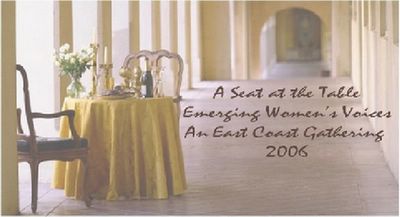
You are invited to the Table!!!
Emerging Women's Voices
An East Coast Gathering 2006
October 1 - 3
Virginia Beach, VA
I'm advertising this on my wife's behalf (she's one of the organizers). The ladies will be staying and meeting at the Sandcastle Oceanfront Resort in Virginia Beach.
The theme will be "A Seat At the Table" and will offer many 'table gatherings' (sessions) to choose from as well as plenty of time to enjoy our beautiful surroundings. The goal of this gathering is to facilitate discussions that are directly related to women, encouraging them to boldly emerge as leaders in this 21st Century. The conversations are inclusive of a diversity of leadership styles and opportunities. The sessions will enable all women to have a voice at the table to dialogue, to learn and to advance their journeys of Christian spiritual formation.
The registration fee is nominal and 'scholarships' will be available to those in financial need. Lodging, transportation and meals are not included.
Registration and more information are available here.
All women are invited to join us at this table, and are encouraged to invite others as well. Please spread the news of this event to any women you know interested in the emerging church conversation.
Emerging Women look forward to sharing a place at the Table with you!
If you have any additional questions please contact:
Julie - emergingwomen@gmail.com
Sherri - sherace@aol.com
Liz - mizliz00725@hotmail.com
Tuesday, July 18, 2006
Special Guest at up/rooted
If you didn't hear the news yet, up/rooted will be visited this month by Wahu Kaara, a current Kenyan presidential candidate and 2005 Nobel Peace Prize nominee for her work fighting global poverty. The Psalters will also be joining us to grace us with their musical talents. You will not want to miss this unique opportunity as Ms. Kaara challenges us to "Wake Up to Poverty".
The gathering will be on Monday, July 31st, at 7pm. We are meeting at the Socall home at 26W325 Torrey Pines Ct., Winfield, IL 60190.
I hope you all can make it. And please, spread the word. The Socall's home can hold dozens of people, so invite your friends and neighbors to this if you like. And if you've never been to up/rooted before - or especially if you've just heard about us through the recent CBS segment on the emerging church - this would be an excellent first time to join us and get to know our community a little bit.
Blessings,
Mike Clawson
up/rooted co-coordinator
P.S. If you need a ride, please let me know. We can arrange transportation from any of the local Metra stations or other locations (given enough advanced warning). We don't want anyone to miss this for lack of transportation.
The gathering will be on Monday, July 31st, at 7pm. We are meeting at the Socall home at 26W325 Torrey Pines Ct., Winfield, IL 60190.
I hope you all can make it. And please, spread the word. The Socall's home can hold dozens of people, so invite your friends and neighbors to this if you like. And if you've never been to up/rooted before - or especially if you've just heard about us through the recent CBS segment on the emerging church - this would be an excellent first time to join us and get to know our community a little bit.
Blessings,
Mike Clawson
up/rooted co-coordinator
P.S. If you need a ride, please let me know. We can arrange transportation from any of the local Metra stations or other locations (given enough advanced warning). We don't want anyone to miss this for lack of transportation.
Friday, July 14, 2006
We were on the News!
 In case some of you missed it, Channel 2, the local Chicagoland CBS affiliate had a piece this past Monday on the emerging church. Geoff Holsclaw, Dave Fitch, my wife Julie and myself were all interviewed for it and made it into a few brief clips. They also interviewed Scot McKnight up at North Park University and several people from Chicagoland Community Church, an emerging church down in the city that hasn't made the connection to us in up/rooted (yet).
The whole piece was pretty good, though very short and not very detailed. You can read the transcript or see a video of it at the website. They've also included some links to up/rooted and to the others involved in the segment. At any rate, I'm glad for the attention to the emerging church, and I hope it will potentially lead to more people finding out about the movement who were perhaps on the verge of giving up on traditional Christianity.
Friday, June 23, 2006
up/rooted update
Hey friends,
We had a great time this past Monday discussing Brian McLaren's new book, The Secret Message of Jesus. About half of the group hadn't had time to read it, so the rest of us who had took turns explaining for them in our own words what Jesus' "secret message" was according to Brian ("the kingdom of God is among you" as opposed to "believe in Jesus so you can avoid Hell when you die") This very quickly led into a discussion of why Brian chose to use the word "secret" and what he meant by that. Turns out he wasn't just trying to capitalize on the DaVinci Code fanfare and actually made a very good point about Jesus' consistent use of parable, metaphor and indirect answers in his teaching style. One begins to wonder why, if right belief really is so important - literally a matter of heaven and hell - as evangelicals claim that it is, then why wasn't Jesus far more clear in his teaching? Why is he so hard to understand sometimes. As it turns out, Brian explains that perhaps what is more important than having all the answers is being spiritually formed into the kind of people God wants us to be - namely, humble, teachable learners in an interactive relationship with the Teacher.
We continued to talk about some of the implications of Jesus' kingdom message, and asked what was so controversial about this book in the first place. (Not much really, as it turns out, though there are some who are sufficiently opposed to all things emergent that they are bound to dislike anything McLaren puts out these days.) We were fortunate to have Pastor Fred from Redeemer Lutheran with us. His background in the more mainline "social gospel" churches helped give us all a needed perspective to say that Brian's "secret message" is not really anything all that new or radically different. It's the kind of thing that his denomination and Christian circles have been talking about for decades. He encouraged us "post-evangelicals" not to forget about our evangelistic calling in our rush to embrace a more social justice oriented message.
Anyhow, we talked about a lot of other issues related to the book, including eschatology, grace, and our role in bringing about the kingdom. I want to say thank you to everyone who was there and contributed to the discussion. It was a stimulating time, and as always I especially value the opportunity to connect with fellow emergent Christians and leaders from all over the Chicago area. Networking is a beautiful thing. :)
 Our next up/rooted gathering is going to be a very special event hosted by Adventrek on Monday, July 31st at 7pm. We will be joined by Wahu Kaara, a 2005 Nobel Peace Prize Nominee and 2007 Kenyan presidential candidate, as well as the Psalters, a band whose songs cry out for the liberation of the oppressed. Wahu Kaara is the Ecumenical Coordinator for the Millenium Development Goals in Kenya, the founding coordinator of Kenya's debt relief network. Also in 2005 she launched (together with the president of Brazil) a global call to action against poverty in Brazil which has grown into the world's largest anti-poverty movement, with campaign actions in more than 80 countries.
Come join us on the 31st as Ms. Kaara challenges us to "Wake Up to Poverty" followed by inspiring music from the Psalters. The event will be hosted at Kristine Socall's house at 26W325 Torrey Pines Ct, Winfield, IL. For more info go to http://www.adventrek.org.
See you then!
Mike Clawson
up/rooted co-coordinator
We had a great time this past Monday discussing Brian McLaren's new book, The Secret Message of Jesus. About half of the group hadn't had time to read it, so the rest of us who had took turns explaining for them in our own words what Jesus' "secret message" was according to Brian ("the kingdom of God is among you" as opposed to "believe in Jesus so you can avoid Hell when you die") This very quickly led into a discussion of why Brian chose to use the word "secret" and what he meant by that. Turns out he wasn't just trying to capitalize on the DaVinci Code fanfare and actually made a very good point about Jesus' consistent use of parable, metaphor and indirect answers in his teaching style. One begins to wonder why, if right belief really is so important - literally a matter of heaven and hell - as evangelicals claim that it is, then why wasn't Jesus far more clear in his teaching? Why is he so hard to understand sometimes. As it turns out, Brian explains that perhaps what is more important than having all the answers is being spiritually formed into the kind of people God wants us to be - namely, humble, teachable learners in an interactive relationship with the Teacher.
We continued to talk about some of the implications of Jesus' kingdom message, and asked what was so controversial about this book in the first place. (Not much really, as it turns out, though there are some who are sufficiently opposed to all things emergent that they are bound to dislike anything McLaren puts out these days.) We were fortunate to have Pastor Fred from Redeemer Lutheran with us. His background in the more mainline "social gospel" churches helped give us all a needed perspective to say that Brian's "secret message" is not really anything all that new or radically different. It's the kind of thing that his denomination and Christian circles have been talking about for decades. He encouraged us "post-evangelicals" not to forget about our evangelistic calling in our rush to embrace a more social justice oriented message.
Anyhow, we talked about a lot of other issues related to the book, including eschatology, grace, and our role in bringing about the kingdom. I want to say thank you to everyone who was there and contributed to the discussion. It was a stimulating time, and as always I especially value the opportunity to connect with fellow emergent Christians and leaders from all over the Chicago area. Networking is a beautiful thing. :)
Our next up/rooted gathering is going to be a very special event hosted by Adventrek on Monday, July 31st at 7pm. We will be joined by Wahu Kaara, a 2005 Nobel Peace Prize Nominee and 2007 Kenyan presidential candidate, as well as the Psalters, a band whose songs cry out for the liberation of the oppressed. Wahu Kaara is the Ecumenical Coordinator for the Millenium Development Goals in Kenya, the founding coordinator of Kenya's debt relief network. Also in 2005 she launched (together with the president of Brazil) a global call to action against poverty in Brazil which has grown into the world's largest anti-poverty movement, with campaign actions in more than 80 countries.Come join us on the 31st as Ms. Kaara challenges us to "Wake Up to Poverty" followed by inspiring music from the Psalters. The event will be hosted at Kristine Socall's house at 26W325 Torrey Pines Ct, Winfield, IL. For more info go to http://www.adventrek.org.
See you then!
Mike Clawson
up/rooted co-coordinator
Subscribe to:
Posts (Atom)