Tuesday, October 03, 2006

Review of A Heretic's Guide

A month or so ago I promised you all a review of Spencer Burke’s new book, A Heretic’s Guide to Eternity (co-written with Fuller Theological Seminary professor Barry Taylor). Spencer is the founder of TheOoze.com, one of the foremost websites for the emerging church. Anyhow, sorry for the delay, life gets busy. Actually, I’ve been trying to get this review written for the past week, but being sick and then caring for a sick baby has kept getting in the way.

I have to confess that Spencer’s book took me by surprise. All the buzz that I had heard about it focused on Spencer’s supposed “universalism” and that’s what I expected the book would mostly be about. But, as it turns out, that discussion is really only a very minor part of the whole book. Instead, the bulk of the book is about why Spencer thinks institutional religion’s time is past, and how we need to move beyond religion towards spirituality.

Let me say right off the bat that my goal here is not to discuss all the points that I disagreed with in this book and give my own counterpoints. That ground has already been well covered by Professor Scot McKnight at his blog, Jesus Creed. I’d highly recommend reading the dialogue there if you want a more in depth critique. Personally, while I didn’t agree with everything Spencer had to say, I think he did raise some good questions for conversation.

I was actually talking with Spencer on the phone a few weeks ago (arranging a lunch get-together at a conference we’ll both be at in November), and he explained to me that his book is really intended to be evangelistic as much as anything else. In other words, he wasn’t exactly trying to convince bible scholars or Christians who are already pretty certain on their views. He was writing, as I understand it, for the non-Christian who has been turned off by grace-less forms of institutional religion. Spencer also commented that his book really is intended to be a conversation starter, not a full-blown argument for why his views are right.

And start conversation it has. Some have criticized Spencer for using the word “Heretic” in the title of the book. The argument is that he’s not really heretical, he’s just being provocative. In some ways that’s true; I didn’t find a whole lot in the book that I would consider completely outside the bounds of historic Christian belief. On the other hand, there are plenty of others who definitely do think Spencer’s ideas are heretical and are way out of bounds for a Christian to even consider. (For some examples of this, check out the conversation on the Emerging CGGC blog.) Regardless of whether or not Spencer is officially a heretic, his ideas do make a lot of people uncomfortable.

In regards to his ideas, let me start with Spencer’s discussion of religion vs. spirituality. Right away (and this is one of the things I didn’t really like about the book), it’s hard to get a handle on what exactly is meant by these terms. The book doesn’t really give a clear definition. Scot McKnight however does a good job of summing up what he thinks Spencer is getting at

Religion seems to be his term for institutional faith, esp Christianity, in its churchiness, its creeds, and its required commitments. It is finite attempts to capture the infinite (28) and, as I read him, religion is a “consensual illusion” (29). It is designed to “point the way to God, not to control the flow” (40).

Spirituality is equality, a feminine/masculine sense of God, countercultural dynamic, mystery, experience, interconnectedness, beyond authority structures, holistic individuals, the particular rather than the universal, material as much as heavenly, authenticity and honesty, and a communal, holistic celebration of the sacred that eradicates boundaries.


Given these definitions, Spencer says a lot about how religion has become a barrier to people who are honestly seeking God, and how now, in our postmodern era, people are gradually learning to circumvent religion and approach the divine through the freedom of spirituality. He predicts that religion in its institutional forms are destined to die away, and suggests that perhaps we’re entering an age when people will no longer look to institutions to help mediate their relationships with God. As he says on page 90-91,


“People are not leaving churches because they’ve ended their spiritual journey or have abandoned their commitment to the teachings of Jesus… On the contrary, people are leaving the church because they want to embrace something more than abstract ideas and religious dogma. They want a transforming spirituality that gives their life shape and meaning.”


Personally, I think Spencer somewhat overstates his case, though I don’t completely disagree with his assessment. Actually, I was never quite sure how far to take Spencer’s comments. At times he seems to come down pretty hard on “religion”, but I couldn’t quite tell if he really thought that all forms of church and corporate spirituality were worthless or bound for the trash heap. In my own opinion, it is far too premature to write eulogies for institutional religion just yet. I also don’t think that the church, even as an institution, entirely fails at leading people into a transforming spirituality. At least, I have known many people whose lives have been transformed for the better in and through the church.

What I had a hard time figuring out is whether Spencer was saying we needed less church or better church. Is the problem with institutionalized religion altogether, or do we just need better institutions (perhaps scaled back, and based more on horizontal rather than hierarchical relationships and leadership structures)? As someone who is in the process of creating an “institution”, i.e. a local church, I would personally say the latter. I think there is value in the church, and really, I think some institutionalization is inevitable. Human beings like organization. Whenever you have more than a handful of people who get together on a regular basis for spiritual pursuits, you are going to need some kind of structure, some kind of system, some order. At any rate, I think that religion and spirituality are not always opposites. Often the church is an important means for people to find spirituality

At times Spencer doesn’t seem to have entirely given up on the church either. Indeed, on the phone he remarked to me that he still spends the bulk of his time speaking and interacting within the structures of institutional Christianity (i.e. churches, conferences, publishers, etc.), so I would guess that he still sees something there worth being redeemed.

Spencer’s main complaint against institutional religion, however, seems to be the ways in which it seeks to exclude people from God’s grace. He writes several chapters about how religion likes to set itself up as the gatekeepers of heaven, determining who gets in and who doesn’t. Instead, Spencer suggests that we should stop worrying about who is “in” and “out” altogether. The important thing, according to Spencer, is “not a belief system, but a holistic approach of following what you feel, experience, discover, and believe; it is a willingness to join Jesus in his vision for a transformed humanity.” (131) The true purpose of the church then, “is to take on a facilitating role, helping people find their way with God rather than attempting to determine and control exactly what that relationship to God “must” look like.” (132)

This is where Spencer’s “universalism” comes in. I say that in quotes because Spencer is not actually a universalist. While he uses that term in the book, he does so rather “tongue-in-cheek”. He is a “universalist that believes in Hell”, which is to say, not really a universalist. Rather, Spencer is an extreme inclusivist. His suggestion is basically that perhaps salvation is an opt-out rather than an opt-in. In other words, God’s grace and forgiveness is already extended to all people. Because of what Christ did on the Cross, we are all “saved”, i.e. recipients of God’s grace right from the day we are born. However, because we still have free will, and because God will never force anyone to love him, we all still have the option of rejecting God’s grace, of refusing his love. Perhaps, suggests Spencer, salvation is not so much about intellectually assenting to the particular doctrines of the Christian religion, but is simply about responding to God’s love and accepting his free grace to us, in whatever form it appears. (Incidentally, I think this whole view would help greatly in making sense of what Paul says in Romans 5:12-19.)

Personally, I think Spencer is on to something. I think many of his ideas: his inclusivism, his opinion that faith is more about spiritual transformation than intellectual orthodoxy, and his vision for a church that serves as facilitators and tour guides to faith rather than as gate keepers to heaven – these are all valuable contributions to the conversation. They are ideas that are worth pursuing further – and many already have, from Brian McLaren to NT Wright to Dallas Willard. My disappointment however, is that Spencer himself doesn’t do a very good job of supporting his ideas with much deep biblical thinking or persuasive argument. Again, as he told me, that wasn’t his intention in the first place, he wasn’t trying to convince Christians to all agree with him. However, these issues are important enough that I’d hate to see a lot of Christians simply dismiss them because of Spencer’s lack of intellectual or biblical rigor.

In short, my own earlier prediction about this book was proved true: I liked some of the answers in Spencer's book, but not how he arrived at them. And I disliked some of his answers, but still really value the questions they were born out of.

If anyone is interested, perhaps we'll have a discussion of A Heretic's Guide at up/rooted sometime in the next few months. Let me know what you think.

-Mike

Saturday, September 30, 2006

up/rooted recap

Greetings up/rooted friends!

It was great spending time with so many of you again last night; and it was especially great to meet so many new folks as well. We had quite the diverse group, from at least five different Midwestern states, all there to hear Doug Pagitt speak. Besides our regulars from the Chicago area, and Doug himself who hails from the frozen tundra of Minnesota, we had a group from eastern Iowa make the drive in order to gain some insight in hopes of starting a cohort in that area as well. We also had a representative from a sister cohort in west Michigan visiting last night too. (We might even count Wisconsin, as we had a friend join us who lives in Illinois but pastors a church up in Milwaukee - plus our beer was from Wisconsin.) At any rate, it was a great time of good food and making new friends as well as renewing old acquaintances.

Our time with Doug was very informal. After we each introduced ourselves we just opened it up to questions for Doug. Most of the discussion revolved around Solomon's Porch, the church community that he pastors up in the Twin Cities, which he described in his first book, Church Re-Imagined. Doug began by telling us the story of how they chose the name of the church and how they got it started. Rather than telling us how The Porch is different than other churches (though I guess it has something to do with a 10 foot paper mache goose that hangs over Doug's head when he talks), he began describing for us what it is like, i.e. how it is similar to other faith traditions and how they value these various streams of the faith. However, this discussion quickly led into asking Doug to describe for us the unique way that they do their sermon/biblical study time, or what Doug calls "Progressional Implicatory Preaching" - which just happens to be the subject of his second book, Preaching Re-Imagined. This led us into some practical questions of how to balance difficult personalities and disagreements in doctrine in such an interactive format, as well as how to keep the notoriety Solomon's Porch has acquired from ruining the dynamic. (To which Doug's reply was "We're just not a show pony.") On the other hand, others wanted to know how kids and adolescents are integrated into the life of the church, while still others wondered about the missional dynamic at The Porch and how that gets lived out practically.

It would take too long for me to try and summarize everything Doug said in reply to all these great questions and all the others that were asked last night. But fortunately, if you want his answers to at least some of them, you can simply pick up a copy of the book and read all about it. I know that for me, Solomon's Porch has been an inspiration for the kind of church we want our new church plant, Via Christus, to be like.

Doug wrapped up the night by leading us in a Body Prayer, which is a practice they use in their church of praying through the symbolic postures of one's body rather than through mere words. Incidentally, this is also the subject of Doug's third book, Body Prayer.

We have another very special and unique event for up/rooted next month. Rather than a "normal" small group discussion gathering, you are all invited to a Faith and Politics Forum on Immigration that I am helping to coordinate with several other pastors and churches in the Fox Valley area. It will be an open "town hall" style forum with a panel discussion of several local pastors and practitioners on the question of how we should look at issues of illegal immigration through the lens of faith. If you'd like to come and contribute to the discussion or just observe and learn, please join us at 7pm on Monday, October 23rd at St. Mark's Lutheran Church in Aurora.

Hope to see you there!

-Mike Clawson
up/rooted co-coordinator

Thursday, September 21, 2006

Question #2: The Emerging Church and the Holy Spirit

Okay, here's the next question for open discussion:

How do we as postmodern/post-charismatic/post-noncharismatics view an active relationship with the Holy Spirit?

Let's hear your thoughts!

Monday, September 18, 2006

Doug Pagitt coming to up/rooted

Hey friends!

Our next up/rooted gathering will be on Thursday evening, September 28 at 7 PM, and we will be joined by special guest Doug Pagitt, pastor of Solomon's Porch, author of the books Church Re-Imagined and Preaching Re-Imagined (among others), and the orginator of what has become Emergent. We'll be gatheing at the Socall home, 26W325 Torrey Pines Ct., Winfield, IL 60190. This is an open invitation, so please, spread the word - invite your friends and pastors.

Blessings,

Mike Clawson
up/rooted co-coordinator


BTW, please feel free to bring appetizers, desserts or drinks to share if you want to.

Tuesday, September 12, 2006

Question #1: Universalism

Hey all, I promised that I would post here some of the questions that were suggested by up/rooted folks last month that we didn't have time to discuss that night. Let's discuss them here!

Here's the first question (actually there were two that were very similar so I'll lump them together):


How wide is salvation? (I.e. exclusivism/inclusivism/universalism)

and

What would it mean to be an evangelical universalist? What is the theological foundation for such a coupling?


Dive in! Post your thoughts here.

Tuesday, August 29, 2006

A Literal and Spiritual Potluck

Hey up/rooted friends!

As you know, we gathered again for up/rooted last night at Kristine Socall's home for good food and even better discussion. We reveled in humus and pita, Rosati's pizza, spinach artichoke dip, fresh home-grown tomato and mozarella bruschetta, and a number of other excellent dishes. After a time of renewing friendships over great food, we adjourned to the living room where we decided to each contribute one question to a big, fuzzy Russian hat from whence we drew and discussed.

Of course, with discussion as free flowing and lively as it ever is at up/rooted, we only had time for two of the questions suggested that night. The first we drew was from Pastor Fred of Redeemer Church in Park Ridge. His read:

"We are starting a new worship gathering on Sunday nites. For you, what are the values for worship in a postmodern context?"

It had been a while since we had addressed questions of worship styles and methods at up/rooted, so this was a great topic for us to get into together. We discussed what the purpose or goals of worship were. This led us into considering whether more charismatic group experiences or more individualistic contemplative experiences were preferable (or, if both are, to what degree of each). We also discussed the aesthetics of worship, and how worship should be an act that engages both the mind and the senses. Those with a more liturgical background brought up questions about the reasons for and value of liturgy, and Stephen especially shared about the uniqueness of his charismatic episcopal church, Church of the Resurrection.

BTW, Pastor Fred also encourage anyone from the up/rooted community to email him if you have any further suggestions or advice on starting a postmodern worship service. You can reach him at fjn113@comcast.net.

The second question of the night was from my wife Julie. She asked:

"Are Statements of Faith good or bad? Are they necessary or do they draw unnecessary lines?"

We began by discussing how Statements of Faith often help us know ahead of time what kind of church we're dealing with, if we are skilled at reading between the lines, and how there is value in being up front and honest about what is most important to your church. However, we also talked about the dangers of labeling and pigeonholing a church based on their beliefs without really getting to know the true personality of the church. It was also generally agreed that the more minimalist a Statement of Faith can be, the better, so that rather than drawing lines of "in" and "out", a church can be open to conversation and a diversity of viewpoints (realizing that this is sometimes easier said than done). My contribution was that a Statement of Faith, if a church has one, should be more about telling the basic story of our faith rather than about drawing lines on every little theological debate. For instance, our church, Via Christus, uses nothing more than the Apostles Creed as its Statement of Faith.

For the other questions that we didn't have time to discuss, I will be posting them here at our up/rooted blog every few days or so, and I encourage you all to dive into discussion of them. So if you've wanted to be involved in up/rooted but don't have time to get out to our gatherings regularly, here's your chance to contribute to the conversation online.

Our next up/rooted gathering will be on Thursday, September 28, and we will be joined by special guest Doug Pagitt, pastor of Solomon's Porch, author of the books Church Re-Imagined and Preaching Re-Imagined, and the orginal founder of what has become Emergent. Spread the word, invite your friends and pastors, and stay tuned for time and location details.

Blessings,

Mike Clawson
up/rooted co-coordinator

Monday, August 21, 2006

Wahu Kaara Download

Hey all,

A while back I promised a download of the speach by Wahu Kaara, the Kenyan presidential candidate and Nobel Peace Prize nominee that spoke to us a few weeks ago. It's finally online for those of you who couldn't make it to Winfield that night. You can download it here.

-Mike

Friday, August 18, 2006

August up/rooted gathering coming up

Hi friends,

I just wanted to let you know that we'll be meeting again for up/rooted a week from this Monday, August 28, from 7-9pm at the Socall home, 26W325 Torrey Pines Ct., Winfield, IL 60190. This will be a more informal gathering, and we'll do it potluck style, so bring some food to share and questions to discuss - anything you feel like talking about it fine.

Also, as a sneak preview, we may have the chance of hearing from Doug Pagitt - pastor of Solomon's Porch, founder of Emergent, and author of Church Re-Imagined - at our September gathering. I'll let you know more details as we get them worked out.

As always, contact me with any questions or if you need a ride. Hope to see you then!

Mike Clawson
up/rooted co-coordinator

Thursday, August 10, 2006

A Heretic's Guide to Eternity

I have another teaser/trailer for you all. As with Brian McLaren's book, The Secret Message of Jesus, I've again been asked to review an advance copy of another book, this time one entitled A Heretic's Guide to Eternity by Spencer Burke, the creator of TheOoze.com, one of my favorite emergent websites. In this book Spencer questions our traditional notions of grace and salvation, proposing the heretical possibility that salvation might be an "opt out" deal rather than an "opt in". (As Spencer said to me at at conference I met him at once, "I'm a universalist that believes in Hell.")
I think this is an incredibly important issue for Christians to wrestle with, even if one doesn't come to a full agreement with Spencer's position. However, my prediction is that most Christians, even those within the emerging church movement, will likely have too much to lose to risk showing support for - or even a mild interest in - Spencer's ideas. Universalism (of any variety) is still a dangerous (and yes, heretical) idea in most conservative Christian circles. As a minister, to "come out" as a universalist will 1) get you fired; 2) cause people to leave your church; 3) lose a big chunk of your missionary support; 4) get your in-laws to start praying for you to recover your lost faith; 5) keep you from being taken seriously or shown much respect within evangelical circles ever again. In short you will be written off as a heretic, end of story.

Fortunately for Spencer, he has already largely disentangled himself from insitutional Christianity and the evangelical establishment over the past decade or so, and will probably not sweat it too much if he doesn't get a positive review in Christianity Today. Indeed, a good chunk of the book seems to be not just about universalism, but also about the stifling effect of institutionalized religion on true spirituality. At any rate, I fully expect this book to be mostly panned by evangelical (and even emergent) critics. I just hope that at least a few bloggers will have the balls to admit that they too wrestle with the questions of who is actually saved or not and why, and that they sometimes hope/wonder that God's grace might in fact be much wider than we're often led to believe.

Anyhow, I've just begun reading the book, so I'll post a real review of it here in a week or two once I'm all the way through. (I'm a pretty slow reader.) Stay tuned!

Monday, August 07, 2006

Hey up/rooted friends!

Last week about 100 of us crowded into Kristine and Brian Socall's home in Winfield to hear an amazing lady from Kenya speak to us about global poverty and what we as American citizens can do about it. It was an amazing night. With her permission, I wanted to share my wife, Julie's, comments on the evening (also posted at the Emerging Women's blog):


Last night I went to hear Nobel Peace Prize nominee and 2007 Kenyan presidential candidate Wahu Kaara speak. The occasion was an event called Wake up to Poverty and Kaara fearlessly called on us suburbanite Americans to wake up and care.

Kaara, the founding coordinator of the Kenya Debt Relief Network, is also the Ecumenical Coordinator for the Millennium Development Goals in Kenya at the All Africa Conference of Churches. With Brazilian President Luis Inácio Lula da Silva, Kaara launched the Global Call to Action against Poverty in Brazil in 2005, which has grown into the world's largest anti-poverty movement. Its organizations together represent more than 150 million people globally, with campaign actions in more than 80 countries.

What amazed me is how her role as a woman is helping change the world. She was one of the lucky women in Kenya who was blessed with an education. She had a comfortable life first as a teacher then as a school principal. Yet she saw the conditions of her people living under systems of oppression (often inflicted by countries like the US) and realized that she had to do more. She said she saw how in communities in Kenya the women formed networks of support to help care for each other and that inspired her to create networks to help end global poverty.

The groups she has founded have made tremendous impact already. And she is running for the Kenyan Presidency with strong goals and dreams (in many ways aiming at nothing less than ending poverty and helping form a United States of Africa). Her call to us was to wake up to poverty and see the need for aid without conditions, just trade, and debt relief. She wasn't afraid to touch issues that American Christians usually avoid – ones that point out the sinfulness of certain policies, the greed of corporations, and the pain our consumeristic ways causes to other countries and the environment. This wasn't some college hippie liberal ranting about the government, this was an educated leader who has lived through and amidst the pain asking us to open our eyes, be educated, and work for change.

Most encouraging was that even amidst the vastness of the problems (poverty, debt, disease), Kaara had hope. She no longer wants Africa to be seen as a desperate, hopeless continent, but as a living continent. She has hope and has strategies and plans for making it happen. Some of that involves people in America pressuring our representatives to set the standard for the world in participating in the Jubilee of debt relief and aid.

In all it was a fascinating evening listening to a women who has looked at a problem and is stepping up to fix it. She is a modern hero and role model for women.


Brian from Adventrek (the group that helped sponsor this event and bring Ms. Kaara here) has promised to put the audio of Wahu Kaara's talk online soon. I'll send out the link as soon as that's up.

We don't have a date or topic yet for our next up/rooted gathering. I'll let you all know as soon as we get that figured out.

Blessings,

Mike Clawson
up/rooted co-coordinator

Tuesday, July 25, 2006

Wake Up To Poverty, July 31st

Nobel Peace Prize nominee and 2007 Kenyan presidential candidate Wahu Kaara will speak on global poverty and social transformation on July 31, 2006 at 7:00 p.m. at 26W325 Torrey Pines Court in Winfield, IL.  

Her talk is part of an evening called “Wake Up to Poverty” and will be followed by a concert from Psalters, an experimental folk rock group influenced by the music born out of generations of cultures that have struggled with oppression.

Kaara, the founding coordinator of the Kenya Debt Relief Network, is also the Ecumenical Coordinator for the Millennium Development Goals in Kenya at the All Africa Conference of Churches.  

With Brazilian President Luis Inácio Lula da Silva, Kaara launched the Global Call to Action against Poverty in Brazil in 2005, which has grown into the world's largest anti-poverty movement.  Its organizations together represent more than 150 million people globally, with campaign actions in more than 80 countries.

“Wake Up to Poverty” is sponsored by Adventrek, a not-for-profit organization, created to foster individual and community transformation through social justice events and educational service trips.  Adventrek affirms, in the words of Wahu Kaara that, “It is obvious that we as a civilization are at a critical juncture that calls upon us to rethink our destiny. This is not a small task and will not be accomplished overnight. But its mere admission calls for us to dialogue.”  On July 31, 2006, all are invited to share in this ongoing dialogue and will be encouraged to wake up to poverty.

For more information, please contact Brian Socall at 630.668.4564 or email brian@adventrek.org.

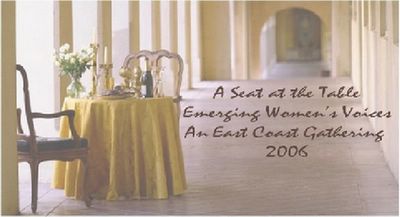
Emerging Women East Coast Gathering


You are invited to the Table!!!

Emerging Women's Voices
An East Coast Gathering 2006

October 1 - 3
Virginia Beach, VA

I'm advertising this on my wife's behalf (she's one of the organizers). The ladies will be staying and meeting at the Sandcastle Oceanfront Resort in Virginia Beach.

The theme will be "A Seat At the Table" and will offer many 'table gatherings' (sessions) to choose from as well as plenty of time to enjoy our beautiful surroundings. The goal of this gathering is to facilitate discussions that are directly related to women, encouraging them to boldly emerge as leaders in this 21st Century. The conversations are inclusive of a diversity of leadership styles and opportunities. The sessions will enable all women to have a voice at the table to dialogue, to learn and to advance their journeys of Christian spiritual formation.

The registration fee is nominal and 'scholarships' will be available to those in financial need. Lodging, transportation and meals are not included.

Registration and more information are available here.

All women are invited to join us at this table, and are encouraged to invite others as well. Please spread the news of this event to any women you know interested in the emerging church conversation.

Emerging Women look forward to sharing a place at the Table with you!

If you have any additional questions please contact:

Julie - emergingwomen@gmail.com
Sherri - sherace@aol.com
Liz - mizliz00725@hotmail.com

Tuesday, July 18, 2006

Special Guest at up/rooted

If you didn't hear the news yet, up/rooted will be visited this month by Wahu Kaara, a current Kenyan presidential candidate and 2005 Nobel Peace Prize nominee for her work fighting global poverty. The Psalters will also be joining us to grace us with their musical talents. You will not want to miss this unique opportunity as Ms. Kaara challenges us to "Wake Up to Poverty".

The gathering will be on Monday, July 31st, at 7pm. We are meeting at the Socall home at 26W325 Torrey Pines Ct., Winfield, IL 60190.

I hope you all can make it. And please, spread the word. The Socall's home can hold dozens of people, so invite your friends and neighbors to this if you like. And if you've never been to up/rooted before - or especially if you've just heard about us through the recent CBS segment on the emerging church - this would be an excellent first time to join us and get to know our community a little bit.

Blessings,

Mike Clawson
up/rooted co-coordinator


P.S. If you need a ride, please let me know. We can arrange transportation from any of the local Metra stations or other locations (given enough advanced warning). We don't want anyone to miss this for lack of transportation.

Friday, July 14, 2006

We were on the News!

In case some of you missed it, Channel 2, the local Chicagoland CBS affiliate had a piece this past Monday on the emerging church. Geoff Holsclaw, Dave Fitch, my wife Julie and myself were all interviewed for it and made it into a few brief clips. They also interviewed Scot McKnight up at North Park University and several people from Chicagoland Community Church, an emerging church down in the city that hasn't made the connection to us in up/rooted (yet).

The whole piece was pretty good, though very short and not very detailed. You can read the transcript or see a video of it at the website. They've also included some links to up/rooted and to the others involved in the segment. At any rate, I'm glad for the attention to the emerging church, and I hope it will potentially lead to more people finding out about the movement who were perhaps on the verge of giving up on traditional Christianity.

Friday, June 23, 2006

up/rooted update

Hey friends,

We had a great time this past Monday discussing Brian McLaren's new book, The Secret Message of Jesus. About half of the group hadn't had time to read it, so the rest of us who had took turns explaining for them in our own words what Jesus' "secret message" was according to Brian ("the kingdom of God is among you" as opposed to "believe in Jesus so you can avoid Hell when you die") This very quickly led into a discussion of why Brian chose to use the word "secret" and what he meant by that. Turns out he wasn't just trying to capitalize on the DaVinci Code fanfare and actually made a very good point about Jesus' consistent use of parable, metaphor and indirect answers in his teaching style. One begins to wonder why, if right belief really is so important - literally a matter of heaven and hell - as evangelicals claim that it is, then why wasn't Jesus far more clear in his teaching? Why is he so hard to understand sometimes. As it turns out, Brian explains that perhaps what is more important than having all the answers is being spiritually formed into the kind of people God wants us to be - namely, humble, teachable learners in an interactive relationship with the Teacher.

We continued to talk about some of the implications of Jesus' kingdom message, and asked what was so controversial about this book in the first place. (Not much really, as it turns out, though there are some who are sufficiently opposed to all things emergent that they are bound to dislike anything McLaren puts out these days.) We were fortunate to have Pastor Fred from Redeemer Lutheran with us. His background in the more mainline "social gospel" churches helped give us all a needed perspective to say that Brian's "secret message" is not really anything all that new or radically different. It's the kind of thing that his denomination and Christian circles have been talking about for decades. He encouraged us "post-evangelicals" not to forget about our evangelistic calling in our rush to embrace a more social justice oriented message.

Anyhow, we talked about a lot of other issues related to the book, including eschatology, grace, and our role in bringing about the kingdom. I want to say thank you to everyone who was there and contributed to the discussion. It was a stimulating time, and as always I especially value the opportunity to connect with fellow emergent Christians and leaders from all over the Chicago area. Networking is a beautiful thing. :)

Our next up/rooted gathering is going to be a very special event hosted by Adventrek on Monday, July 31st at 7pm. We will be joined by Wahu Kaara, a 2005 Nobel Peace Prize Nominee and 2007 Kenyan presidential candidate, as well as the Psalters, a band whose songs cry out for the liberation of the oppressed. Wahu Kaara is the Ecumenical Coordinator for the Millenium Development Goals in Kenya, the founding coordinator of Kenya's debt relief network. Also in 2005 she launched (together with the president of Brazil) a global call to action against poverty in Brazil which has grown into the world's largest anti-poverty movement, with campaign actions in more than 80 countries.

Come join us on the 31st as Ms. Kaara challenges us to "Wake Up to Poverty" followed by inspiring music from the Psalters. The event will be hosted at Kristine Socall's house at 26W325 Torrey Pines Ct, Winfield, IL. For more info go to http://www.adventrek.org.

See you then!

Mike Clawson
up/rooted co-coordinator

Wednesday, June 14, 2006

Discuss the Secret Message of Jesus

Hey friends,

Last month up/rooted got together as Kristine led us in a brainstorming and discussion session on new models for thinking about the church. We compared and contrasted the attractional-dualistic-heirarchical model of church with an approach that is incarnational-messianic(wholistic)-apostolic. It was a fruitfull discussion, especially for me personally as I was able to take a lot of the concepts back to our church plant and use them to help our Vision Team acquire a more unified vision for the kind of church we want to be.

I apologize for not getting a fuller summary out this month, life gets in the way sometimes. I guess it's too late now, as I wouldn't be able to remember too many of the details of our conversation anyway. But anyhow, I did want to remind you all that up/rooted is meeting again this coming Monday, June 19 from 7-9pm. Since it's summer time now and warmer we've decided to change our meeting location (again) back to Wheaton College, and specifically the patio in front of the Stupe/Beamer Center. That way we can sit outside if it's nice, and we can always move inside if it gets rainy, cold or dark. I hope that works for everyone.

We'll be discussing together Brian McLaren's new book, The Secret Message of Jesus (you can read a sample chapter here). If you have it, read it. If you've read it, skim over it again. If you don't have it, buy it and read as much of it as you can before Monday. As you read jot thoughts and questions down in the margins, then come to up/rooted on Monday to discuss the following questions:

  • What did you like best?
  • What didn't you understand?
  • What didn't you agree with?
  • What seems most relevant to your life?
  • What questions does this book raise for further study or discussion?

Hope you can make it! See you there!

Blessings,

Mike Clawson
up/rooted co-coordinator
http://www.up-rooted.com

Tuesday, May 30, 2006

Next up/rooted gathering

Hey everyone,

Sorry about the delay in getting a summary of our last up/rooted gathering out to you all. We had a great brainstorming session about new models of church led by Kristine and based on concepts from the book The Shaping of Things to Come.

When I get more time I will try to send a summary of our discussion. However, I wanted to get out a reminder for our next meeting as soon as possible since it will involve some reading. We'll be meeting next on Monday, June 19 from 7-9pm at the Caribou in Glen Ellyn to discuss Brian McLaren's new book The Secret Message of Jesus. I know this is somewhat short notice, so if you don't have time between now and then to acquire and read the whole book, come anyway. We'll extend the discussion into upcoming months if we need to.

I look forward to seeing you guys there. And as always, if you need a ride please let me know.

Blessings,

Mike

Tuesday, May 23, 2006

ONE TV Special tonight

Tonight, NBC Nightly News with Brian Williams will be doing a feature on the ONE campaign, and following Bono to Africa to highlight the critical issues going on there: starts at 5:30 CST.

If you are in the DuPage suburbs area, there will be a watch party at the Socall home and a discussion afterwards on what social justice means in the suburbs.

The special starts at 5:30pm, so be there a little early. Don't forget to bring something to eat and share!

Look forward to seeing you. Bring a friend. Bring a dish. Bring your favorite Bono story.

26W325 Torrey Pines Ct
Winfield, IL 60190

Tuesday, May 23rd @5:30pm CST.

Saturday, May 20, 2006

Emerging Women's Blog

A few weeks back my wife, Julie, had a chance to attend the Emergent Women's ReGathering outside of Indianapolis. Several dozen women met to encourage one another, share stories and ideas, and discuss the role of women in this emerging church movement. As a follow up my wife created a blog for further discussion. If you are a woman within the emerging church movement or know any, and would like to participate you are invited to visit the Emerging Women's Blog.

Here's what my wife had to say about the blog:

I envision this space as a gathering place of sorts for women with some connection to the emerging conversation. It can be used to discuss ideas, theology, philosophy, and praxis. It can be a space to share frustrations as a woman, as a believer, or as an emerging thinker. It can be a place to share what you have written, to ask questions, to share experiences, recommend books, to encourage and give advice, or whatever we feel like making it. I hope we will use it and gain and grow from it.

Saturday, April 22, 2006

up/rooted discusses Wal-Mart

Greetings!

I apologize for not getting a summary of our last up/rooted gathering out sooner. We last met on the Monday before Easter, but since then I've been crazy busy with preparations for our church plant's big Easter kick-off.

We met on the tenth at Kristine Socall's home to view and discuss the documentary, Wal-Mart: the High Cost of Low Price. It was a disturbing look into the many unethical business practices of the world's second largest corporation (after Exxon). Of course they began by talking about the damage that Wal-Mart does to local businesses in small communities (an effect that I myself have personally experienced in several of the small rural communities I've lived in around the state of Michigan). They also mentioned the absurdly low wages and lack of decent benefits that Wal-Mart associates labor under. Apparently full-time Wal-Mart employees make so little that they still qualify for welfare, food stamps and government healthcare... and Wal-Mart's official benefits policy actually encourages their employees to apply for government assistance! But when Wal-Mart employees try to unionize to demand a living wage, the corporation goes into high-alert and utilizes rather extreme tactics to squash any unionizing attempts. The film also discussed the sweatshop conditions in China that Wal-Mart products are produced in, and the ecological damage that Wal-Mart stores often cause to their local environments.

For a short, and very humorous online cartoon that raises many of the same issues check out the "I've Got Friends With Low Wages" music video at http://walmartworkersrights.org/.

In short, the film raised a whole host of issues that make it clear that shopping (or not-shopping) at Wal-Mart is a practice directly related to how we live as followers of Christ that desire to stand against injustice in this world.

Of course, we didn't find any easy answers to how we should respond to these glaring issues. We talked about practical things like supporting local businesses, applying consumer pressure on Wal-Mart and writing to store managers and CEO's with our concerns. We also talked about deeper issues of consumerism and greed, and how to escape the materialistic trap of modern society altogether through practices of simplicity. We wondered together what the alternative to a Wal-Mart style economy could possibly be, and how to get there, given that giant corporations aren't going to be going away anytime soon. We explored ideas about subverting the system from the inside, so to speak, by influencing actual Wal-Mart managers and executives to make more ethical decisions.

Some might question whether these kind of concerns are really "faith" issues. We talked together about how whenever problems like these are raised it is easy for people to label them with terms like "liberal" or "hippie" and thereby dismiss them as important issues. But when one reads a Bible that says things like ""This is the kind of fast day I'm after [says the LORD]: to break the chains of injustice, get rid of exploitation in the workplace, free the oppressed, cancel debts...get rid of unfair practices." (Isaiah 58:6) you begin to see that fair wages and just business practices are the kinds of things God is passionate about too. Many of us agreed that these were not just "activist" issues, these were gospel issues.

At any rate, this discussion wrapped up our series on social justice issues at up/rooted. In May we are going to turn our attention to questions of how we "do church". Specifically looking at alternative models of church, such as house churches, intentional communities, cell churches and comparing them to more traditional or even mega-church models. Come help us explore the question of what the right way to do church really is. ;)

We will be gathering at the Caribou Coffee shop in Glen Ellyn near the corner of Roosevelt Rd and Main St just one mile west of I-355 on Monday, May 8 from 7-9pm. Hope you can make it!

Blessings,

-Mike Clawson
up/rooted.west co-coordinator

Monday, March 27, 2006

The Secret Message of Jesus

Hey all, here's my review of Brian McLaren’s latest book, The Secret Message of Jesus, that I promised:

This book should finally lay to rest any complaints that Brian is too often vague and evasive in stating what exactly he does believe about the gospel. In this book he is crystal clear. Bottom line: it’s about the kingdom of God.

Of course, that’s not to say that Brian purports to answer every question or spell out a detailed systematic theology. Instead, rather true to form, he paints us a picture with broad strokes, giving us a new way to look at what Jesus and his gospel were all about. And he does it with a remarkable clarity and simplicity.

Indeed, the most surprising thing about this book is that it seems to have been written as much for non-Christian seekers as for fellow Christians. This is a book you could give to your “spiritual but not religious” friends who might be interested in learning more about Jesus. In fact, when I saw the cover art along with the title touting a secret message of Jesus I couldn’t help but wonder if Brian and/or the publishers were hoping to tap into all the buzz about the DaVinci Code. People these days seem to be really fascinated with “lost gospels” and suppressed (“secret”?) truths within Christianity; so one can imagine a seeker picking up Brian’s book in hopes of finding more in this vein. (Not that I think this is a bad thing. One of my good friends came to Christ in part because his interest in apocryphal gospels led him to bring his questions to my youth group.)

However, I have to admit that when I first heard the title I did raise an eyebrow. I was worried that talking about Jesus’ “secret” message might imply some kind of Gnostic insight that only truly enlightened (emergent?) Christians really understand. However, I was relieved to discover that Brian’s use of the word was instead intended to raise questions about the lack of clarity we often find in Christ’s teachings. After all, Jesus’ own disciples complain about him using parables all the time rather than just speaking clearly, and Jesus admits that he’s being deliberately obscure (Matthew 13:10-15). So Brian raises the question:

“What if Jesus had actually concealed his deepest message, not trying to make it overt and obvious but intentionally hiding it as a treasure one must seek in order to find? If that’s the case, why would Jesus ever do such a thing?” (p. 4)

Once Brian raised this issue I realized that I too had often been puzzled by this in the Bible. If knowledge of the truth is so very important, then why couldn’t Jesus have just spoken more clearly and told us everything we needed to know. Why did he speak in parables rather than in doctrinal statements? Why does the Bible contain letters and poems and stories rather than systematic theology?

What Brian suggests is that perhaps Jesus’ purpose was not to simply impart knowledge. Instead maybe Christ’s goal was to effect spiritual transformation in the lives of his hearers; and maybe this goal is best achieved by means of parables and other similar forms of communicating. In his chapter on “The Medium of the Message” Brian states:

“If the goal is an interactive relationship (which is at the heart of terms like kingdom of God and eternal life), a parable succeeds where easy answers and obvious explanations couldn’t. With a clear and easy explanation, hearers can listen and achieve understanding and then go on their way, independent of the teacher. But when the parable confounds them, they must come back to interact; they continue to depend on the teacher himself, not just their independent understanding of his words… So parables have this capacity that goes beyond informing their hearers; parables also have the power to help form them into interactive, interdependent, humble, inquisitive, and persistent people.” (p. 46)

But what is Jesus’ secret message then? According to Brian, it comes down to the idea of the kingdom of God as present, political, social, and personal reality. In other words, he focuses on the fact that Jesus didn’t seem to talk about heaven as some place we go to after we die, but rather as a reality that we can begin to live in here and now (“the kingdom of God is among you!”). And perhaps by living in this reality (according to its ways and values) we can begin to transform the world in such a way as to bring a little bit more of heaven to earth. Brian puts it this way:

“What if Jesus’ secret message reveals a secret plan? What if he didn’t come to start a new religion – but rather came to start a political, social, religious, artistic, economic, intellectual, and spiritual revolution that would give birth to a new world?” (p. 4)

He spends the rest of the book describing this revolution and this new world. The book itself is divided into three main sections. The first, “Excavation: Digging Beneath the Surface to Uncover Jesus’s Message”, dives into the historical and especially the first century Jewish context of Jesus’ message. Of course, to me it seems obvious that if we are to really understand what Jesus is all about we must first understand him through the eyes and ears of his original audience. What astounds me is that there are still some Christians who see this approach as a threat to an “evangelical” understanding of scripture. But if we truly respect the Bible and desire to know what it’s really saying, then wouldn’t we want to look at it first through the lens of its historical and cultural context rather than through the lenses of our systematic theologies? After all, most of our current theologies, whether evangelical or liberal, were developed centuries later in response to very different questions than those that concerned Jesus and his followers.

As Brian uncovers this historical context of the message he shows how it has revolutionary political and social implications, both for Jesus’ time and for ours. Not revolutionary in the sense that Jesus was trying to violently overthrow Rome and set up a new Jewish kingdom in its place, but revolutionary in that Jesus was calling people to live according to the values and practices of a new social order, and swear allegiance to a different Lord than Caesar. This is the thrust of the book’s second section, “Engagement: Grappling with the Meaning of Jesus’s Message”, as Brian more fully explains the implications of Christ’s message of a kingdom of sacrificial love, subtle subversion and radical inclusion.

The third and final section, “Imagination: Exploring How Jesus’ Secret Message Could Change Everything”, discusses the practical and personal implications by examining how this new understanding of Jesus transforms our understanding of social relationships, spiritual practices, as well as the dynamics of just war versus active peacemaking. But Brian wades into even more controversial subjects when he suggests that this new understanding of the gospel requires us to also rethink our traditional understandings of Heaven, Hell and the End Times as well as who is really “in” and “out” of the kingdom and what that means. Without getting too mired down by trying to explain what Brian says about all these topics, I will say that the picture he paints is a far more satisfying and biblically consistent view than many of the ones that I’ve encountered in my theological journey thus far.

Of course, it shouldn’t be assumed that much of what Brian writes is entirely his own creation. This entire book is really a popularization of the work of many respected biblical scholars and historians such as N.T. Wright, Walter Wink, Dallas Willard and C.S. Lewis among others. He is standing on the shoulders of others, but he putting their work in terms that are more accessible to the average lay person, and indeed, even to non-Christians.

And it’s a message that needs to be heard. I had already started piecing this “secret message” together myself through reading some of the same scholars that have influenced this book, but once again Brian succeeds in putting what I was already thinking into words far clearer and more compelling than anything I could have come up with myself. And this understanding of Jesus’ message certainly will change everything for those who embrace it. Many of the perplexing absurdities and dilemmas of evangelical theology simply disappear when seen through this lens; while at the same time one is still challenged by Jesus’ message to reorient one’s whole life according to this new kingdom lifestyle. At least, I know I was.

You should all go buy the book and read it as soon as possible. This is a message that needs to be heard. Not Brian’s message, but Jesus’ message - Jesus true message, stripped of centuries of theological accumulations. This is more than just a new view of the gospel (i.e. new “theology”, new abstract ideas). It’s an invitation to a new kind of life. Jesus secret message is an invitation to live in the Way of the Kingdom. This is the message that we have been committed to teaching and following at our new church plant, Via Christus (the Way of Christ), and it’s a message that I hope all Christians would soon discover, because it’s what we, and the whole world, need to see lived out.

So buy the book, read it, then come join us at up/rooted over the summer months as we discuss it. You can order The Secret Message of Jesus here.

Thursday, March 16, 2006

up/rooted.west update

Hey all,

We had a great time this past Monday night at up/rooted.west, which met at our newest location, the back room of Caribou Coffee in Glen Ellyn. For those of you who couldn't be there I wanted to pass along this update, so that you can share in the experience despite your absence.

The focus of our discussion was on how to practically live out principles of social justice in everyday life, and especially in our [mostly] suburban contexts. We began by brainstorming all the different kinds of issues that relate to "social justice", such as poverty, racism, fair trade, child labor, corporate exploitation, gender issues, care for Creation, etc. We talked about why these issues are of central important to Christians, and even to the message of the gospel itself. Some wondered whether our main purpose in focusing on these issues was so that we could win credibility to then share the gospel, though most agreed after some discussion that the message of the gospel was itself inseparable from compassion and justice for the poor and oppressed (cf. Luke 4:18-19).

We talked about the need to be aware of macro-issues like fair trade and socially conscious consumption, while at the same time being willing to get our hands dirty in actually serving the needs of real people. We especially affirmed the importance of being with the poor in whatever ways possible, so that our calling to service and compassion will be able to just spring naturally out of our relationships with other people.

We wrapped up our time talking about the vital importance of community in helping live according to our principles, and wondered how to go about creating these kind of intentional communities. We all agreed that living out social justice will only be successful if it's done out of a sense of joy and genuine love and not merely out of a feeling of guilt or obligation.

We also brainstormed a list of helpful DVD and book resources dealing with these issues. Here are a few:

Movies/Documentaries
The Constant Gardener
Hotel Rwanda
The Corporation
Wal-Mart: The High Cost of the Low Price
Born into Brothels

Books
The End of Poverty by Jeffrey Sachs
The Irresistible Revolution by Shane Claiborne
The Upside-Down Kingdom by Donald Kraybill
Mustard Seed vs. McWorld by Tom Sine

If any of you have other recommendations please feel free to add them in the comments.

Our next up/rooted.west gathering will be Monday, April 10th. We decided to finish up our past few months of social justice related discussions by watching and discussing the documentary, Wal-Mart: The High Cost of Low Price. We will be meeting at Kristine Socall's home at 26w325 Torrey Pines Ct, Winfield at 6:30pm and starting the movie promptly at 7pm with discussion to follow. Come on out and bring some food or drink to share!

Hope to see you there!

Mike Clawson
up/rooted.west co-coordinator

Tuesday, February 28, 2006

up/rooted.west gathering on Monday, March 13

Greetings up/rooted friends!

We will be meeting again for up/rooted.west on Monday, March 13 from 7-9pm. We will be following up last months discussion on faith, politics and the emerging church with a more personal/practical discussion of how we live out biblical principles of social justice here in suburbia. Come join us as we consider the following questions:

• How does/should social justice play a part in the shaping of our daily routines?
• How might our lives change if we truly lived a life valuing social justice?
• Where might we shop; what products would we buy; how would we spend our money; would we grow a garden; what would we wear?
• How would our entertainment habits change? Would we still pay $9 for a movie and $13 to eat out every other weekend, or would our lives require radical changes in order to truly live out what we believe?

We will be trying out a change of venue this month. We will be meeting in the back room of the Caribou Coffee on Roosevelt Rd in Glen Ellyn (495 E Roosevelt Rd, Glen Ellyn), conveniently located just west of I-355 - which should make it easier for those of you coming from further away. (click here for a map) If you want to come but you need a ride from Wheaton College or from the Metra Station, please contact me and we'll arrange a ride for you.

I hope to see you all there. Bring experiences and stories to share, and bring a friend as well. It's always great to be able to expand our network of friends and fellow travelers.

Blessings,

Mike Clawson
up/rooted.west co-coordinator

Friday, February 24, 2006

Coming Soon

I have a trailer/teaser for all of you. Just tonight I received an advance copy of Brian McLaren's upcoming book, The Secret Message of Jesus. The publishers have asked me to read it and and review it for the various blogs that I contribute to. I can't post my review until after March 7 when the book is released to the general public, so check back here later (or at Emerging CGGC or Emerging Pensees, the other blogs I'll be posting my review to.) But until then, here's a teaser from the introduction:

"Through the years, I have frequently had an uncomfortable feeling that the portrait of Jesus I found in the New Testament didn't fit with the image of Jesus in the church. I'd like to share my search with you, and invite you to be part of it. I don't want to spoil the ending, but I'll let you in on this: the farther I go on this search, the more inspired, moved, challenged, shocked, and motivated I become about the secret message of Jesus... If we succeed in grasping even some fragment of Jesus's secret message, if we take it in and manage not only to look at it but also learn to look through it, my hunch is that our world nd our lives will look very different to us at the end of our exploration. And if that happens deeply enough for enough of us, everything could change."

Thursday, February 16, 2006

Politics, Social Justice and the Emerging Church

Hey all,

We had a great time this past Monday at the Wheaton College Stupe as eight of us discussed the relation of faith and politics especially as related to issues of social justice and ministry to the poor. We were especially blessed by the presence of Jane Fitzjerrell of Mission:USA, an urban ministry to gang members and inmates, providing a bridge for them to escape a life of crime. Her experience working with these issues in downtown Chicago brought a first hand perspective to much of our discussion.

We began by asking the question whether the emerging church (or perhaps the church as a whole) ought to concern itself directly with political issues. We all seemed to agree that the church has a responsibility to serve the needs of the poor and disadvantaged in the world around us, though opinion was diverse on whether this is best done through small, grassroots efforts or through working for change on the macro level (i.e. through politics). We all agreed that as Christians it's not enough simply to hold the poor at arms length and expect government or parachurch programs to help them. We must be involved in the intimate work of being among them, loving them and learning from them as well. However, some in the group felt that any kind of political involvement on the part of churches was an ineffective distraction from this kind of work. There was a sense that churches that focus too much on political issues can become too polarized and compromised by this agenda. Andy from Sojourn made the excellent point that pastors, especially when speaking with authority from the pulpit, should not abuse their position by telling the congregation what to think about particular political issues (for example the War in Iraq). Rather we should help people learn to think on a deeper, theological level about such issues so that they can reach their own conclusions.

On the other hand, several in the group made the point that fixing some problems require deeper structural, systemic change than can be achieved simply through church ministries or small communities. As Martin Luther King Jr said, "We are called to play the Good Samaritan on life's roadside... but one day we must come to see that the whole Jericho road must be transformed so that men and women will not be contstantly beaten and robbed. True compassion is more than flinging a coin to a beggar. It comes to see that a system that produces beggars needs to be repaved." And several of us pointed out that this kind of work will usually involve working with political powers and trying to influence the structures of society.

As with any good discussion, we didn't resolve all the tensions or differences of perspective, though we did all agree that whatever else we do, we must be doing something to work for justice and compassion in this world, and not just talking about it at groups like up/rooted. If you would like to get connected to one such ministry I highly recommend contacting Jane Fitzjerrell at Mission:USA.

Also, don't forget that up/rooted will also be meeting this coming Sunday at North Park University from 5-7pm to hear from Dave Tomlinson. Check out the up/rooted website for more details.

Our next up/rooted.west gathering will most likely be Monday, March 20 at the usual time. The topic and location is still to be determined (we've have an option to meet at the Caribou Coffee in Glen Ellyn instead of Wheaton College) so if you have thoughts on either of those questions please let me know.

Blessings,

Mike Clawson
up/rooted.west co-coordinator

Wednesday, February 15, 2006

up/rooted @ North Park with Dave Tomlinson

It seems our gatherings are coming in bunches right now. We had Tony Jones last month, up/rooted.west a couple of days ago, and this next Sunday we will be hosting Dave Tomlinson .

He will be speaking to us about his new book (which hasn't come out in the US yet), Running into God: Reflections for Ordinary Days, and the narrative theology undergirding it. In this book Tomlinson investigates the sacrament of ordinariness - that we can run into God anywhere, anytime, in any situation, through any person, and how this
everydayness draws us into the Story of God.

We will be meeting on February 19th, from 5pm to 7pm in the Olsson
Lounge in the Seminary Building of North Park University.

Please feel free to bring friends, especially those from around the CITY because there are rumors about the beginning of an up/rooted.city coming soon.

And go here for a map to north park , and a map of north park .


grace and peace be with you,
geoff holsclaw

Thursday, February 02, 2006

up/rooted.west gathering on Monday, February 13th

I wanted to let everyone know that in addition to the Dave Tomlinson thing on February 19th, up/rooted.west will also be gathering this month, on Monday, February 13th from 7-9pm in the Beamer Center at Wheaton College for those of you who can't make it all the way downtown or who just want to get together more often this month.

I've tentatively decided that we'll discuss the relation of the emerging church and politics. It's true that a lot of emergent folks also tend to be more progressive politically, but is this a necessary connection? Are issues of social justice inherent to the Kingdom of God themes that are increasingly at the center of the emerging conversation, or should we steer away from those kinds of discussions for fear of alienating and turning off people who might otherwise be sympathetic to the emerging church? If Emergent as an organization becomes too identified and intertwined with groups like Sojourners will that close off the conversation to people whose conservative leanings are more central to their own beliefs?

Let's talk about it! We can get into specific political issues or just talk about the more general relation of faith and politics, whatever you all prefer.

See you there!

Mike Clawson
up/rooted.west co-coordinator

Tuesday, January 31, 2006

Dave Tomlinson at North Park

It seems our gatherings are coming in bunches right now. Right after gathering with Tony Jones last week, I'm please to announce that we will be hosting Dave Tomlinson. He will be speaking to us about his new book (which hasn't come out in the US yet), Running into God: Reflections for Ordinary Days. In it Tomlinson investigates the sacrament of ordinariness - that we can run into God anywhere, any time, in any situation, through any person, and how this everydayness draws us into the Story of God.

We will be meeting on February 19th, from 5pm to 7pm in the Olsson Lounge in the Seminary Building of North Park University.

If you are planning on coming, please send me an email- holsclaws@netzero.net.

grace and peace be with you,
geoff holsclaw

Thursday, January 26, 2006

up/rooted.west update - Late-night discussion with Tony Jones

This past Sunday we gathered at the home of Kristine Socall in Winfield for a special late-night discussion with Tony Jones, the National Coordinator for Emergent. The forty or so of us that were there had a good time connecting with each other, sharing food, and hearing Tony share with us about the past and future of Emergent.

Tony began by telling us the story of how Emergent originated as a dozen or so friends committed to exploring the intersection of theology and church ministry. Several books, conferences, and a whole movement later, Emergent has evolved as one of the major "servers" (to use Tony's Internet analogy) of this thing called the emerging church. Tony described his vision for Emergent to become a way of connecting and resourcing people who share similar visions for the future of the church. He also talked about his desire for Emergent to become a place where people with good ideas and something to share with the larger church could possibly get their books and materials published and publicized.

Questions from the group for Tony ranged from "What's the difference between the emerging church and anabaptists?" to "What's wrong with Stanley Hauweras?" to "Does a focus on social justice obscure the gospel of Heaven?" to "How does holistic medicine intersect with the emerging church?" to "Is Emergent becoming too institutionalized?"

We are grateful to Tony for taking the time out of his schedule to visit with us. We are looking forward to possibly getting together for a similar time with Dave Tomlinson, author of The Post-Evangelical, who will be at North Park University for a conference in a few weeks. We'll let you know when we find out more about that.

We'll also be having another up/rooted.west gathering sometime in February. I'll let you know as soon as we pick a date. Keep your eyes peeled for that as well.

Peace,

Mike Clawson
up/rooted.west co-coordinator

Thursday, January 12, 2006

Special up/rooted gathering with Tony Jones

Just in case you didn't get the Evite I wanted to remind you all that our next up/rooted gathering for January will be a special discussion with Tony Jones, the National Coordinator for Emergent and author of several great books, including The Sacred Way and Postmodern Youth Ministry. I hope you can join us for an informal yet informative conversation with one of the leaders of the emerging church.

Because of Tony's schedule (he's in town to speak at Wheaton College) we'll be meeting on Sunday, January 22nd at 9pm. We'll be meeting at Kristine Socall's home at 26W325 Torrey Pines Ct, Winfield IL. Despite the late hour we're already expecting 30 people, and space is limited so if you haven't RSVP'd yet through the Evite please do so. If you didn't get the evite for some reason, please let me know ASAP if you are planning to be there. You can email me at mjclawson@hotmail.com.

Also, if you are coming, please bring some drinks or snacks to share.

I'll look forward to seeing you all soon!

Happy New Year!

Mike Clawson
up/rooted.west co-coordinator
http://www.up-rooted.com

Tuesday, December 13, 2005

December 12 up/rooted.west update

We had another great conversation last night at our up/rooted.west meeting at Wheaton College. After spending the first half-hour or so chatting and doing introductions among the nine of us that were there, we migrated from the Phelps Room to the more comfortable chairs in the game room across the hall. Above the noise of pool and foosball we discussed the question of church health and church growth.

Actually our conversation primarily focused on the former. Though we recognized that large megachurches do bring certain advantages and succeed in reaching certain kinds of people at particular points in their faith journey, we seemed to all come to a consensus that personally we each desired a more intimate experience of Christian community than a simple event-driven mega-church.

Kristine pointed out that of course this kind of intimate community is not necessarily antithetical to megachurches. She shared in particular about the changes currently underway at Willow Creek Community Church (the granddaddy of all megachurches), to deemphasize the Sunday events as the entry point for bringing new people into the community. Instead Willow wants to place much more of an emphasis on small groups as being the primary point of contact with non-Christians and the central focus of the life of the church, with the Sunday event then being more of a coming together of all these smaller, home-based communities. It's really a radical change if you think about it, since Willow pretty much pioneered the whole idea of event based church growth. This new direction, if they can pull it off, is in some ways a complete 180 from that model. It'll be interesting to see how it pans out for them.

As the conversation drifted towards discussion of what makes a healthy church in the first place we talked about things like intimate small group communities, a tangible and visible expression of love among the people in the church, an embodied message rather than a mere accumulation of words and preaching, real spiritual transformation occurring in people's lives, and a missional drive to transform the world for God's Kingdom. We shared experiences (both positive and negative) that we have had in churches in our past that either reflected these qualities or not. We were especially enriched by the experiences of one of our new members, Roberta, who has recently come here from Brazil, and was able to share with us her story of coming to Jesus through the love shown to her by her community of faith there in Brazil. What a great gift it was to hear how, even half a world away, God is still at work creating communities that embody Christ's message of love.

Our next up/rooted gathering will be a special event with Tony Jones, the National Coordinator for Emergent, and author of several books, including The Sacred Way and Postmodern Youth Ministry. Tony will be at Wheaton College in mid-January and has asked to meet with up/rooted on Sunday, January 22nd at 9pm. The event will be hosted at Kristine Socall's house in Winfield (26w325 Torrey Pines Ct, Winfield IL 60190) and we'll be doing it potluck style, so if you intend to come please bring some food or drinks to share. In fact please RSVP with Kristine by calling 630-668-6539 or emailing her at kristine(at)gifteddreamers(dot)com so we'll know how many to plan for as there is limited space.

I know 9pm is late for a Sunday but I can guarantee that it will be well worth it. I hope you can make it.

Have a Happy Christmas!

Mike Clawson
up/rooted.west co-coordinator

Sunday, December 04, 2005

December up/rooted.west gathering coming up!

CHURCH HEALTH AND CHURCH GROWTH

What is a healthy church?
Is a healthy church always a growing church?
Is a growing church always a healthy church?
Is the mega-church movement good, bad or a little of both?
Is there a right way to do church?

Come discuss these questions and more at our next up/rooted.west gathering.

MONDAY, DECEMBER 12 from 7-9PM
in the PHELPS ROOM of the BEAMER CENTER at WHEATON COLLEGE


for directions go here: http://www.wheaton.edu/directions.html
and here: http://www.wheaton.edu/welcome/campus_map_brochure.pdf

I hope you can all make it. We need your wisdom and questions.

Happy Christmas!

Mike Clawson
up/rooted.west co-coordinator

Tuesday, November 22, 2005

up/rooted.west update from November 21

Hey everyone!

Those of you present at our November gathering last night can testify to a stimulating and productive conversation about how discipleship and spiritual formation happens within communities of faith. And those of you not present really need to drop back in some time. We miss you! And we especially miss the valuable insight and experience that you each bring to our discussions.

As with any good discussion, the thread weaved all over the place and sparked potential rabbit trails that could have used a good 8 hours each for further discussion. We started off the night asking four questions:

1. What does it mean to "make disciples"?
2. How has disciple-making/spiritual formation happened in the churches?
3. How do we see spiritual formation happening within scripture?
4. How has spiritual formation happened in your own life?

We began with some discussion about the differences between evangelism, discipleship and spiritual formation, and how these have perhaps been neglected or done poorly or well within the modern church. This led us briefly into the question of whether or not large, institutional, highly programmatic churches are the best vehicle for encouraging discipleship and spiritual formation (more on that later). We also talked about whether spiritual transformation is something that we can even affect or whether it is entirely the work of the Holy Spirit.

Mentoring and modeling was one area of discussion that we kept returning to. Biblical models of Christ and the disciples or Paul with Timothy, Titus, etc. seemed to point to a rabbinical style system of people doing life together and learning how to live in the way of Jesus by watching the example of others. We talked some about the difficulty of finding mentors, especially for women who are pursuing a ministry calling and can't find too many other women leaders in the church to learn from, and also for those of us being led in more emergent directions and not finding many older Christian mentors who are willing to go with us down that path.

Another dominant theme in our conversation was the fact that for most of us, significant spiritual transformation has happened most obviously during those times when we have been a part of an intensive missional community focused on a very specific ministry goal - e.g. a camp staff, a mission trip team, a ministry team within a church, etc. We talked about the value of being forced to spend large quantities of time with the same people and being focused together on a single purpose with those people. Many of us longed to make those kinds of experiences the norm for the daily life of the local church, but we wondered how that could happen, especially within a suburban culture where everyone is isolated and over-scheduled as it is. How do we create "monastic" communities that are not isolated from their culture and surroundings, but that at the same time live in a counter-cultural way to over-busy and overly individualized suburbs around us? What would that look like in an existing church, a multi-church ministry (like Emerge), or a brand new church plant like mine in Yorkville.

I for one came away from our discussion with renewed passion and some new ideas and directions for my own ministry, and I hope that others did as well. As we talked about what some of these ideas would look like in practical church settings, our conversation turned to what exactly is the mark of a healthy church, and how church growth ties in to church health. We decided that that should be the topic for next month: CHURCH HEALTH & CHURCH GROWTH.

I hope you'll join us next month on Monday, December 12 from 7-9pm at Wheaton College as we discuss those issues.

See you then!

Mike Clawson
up/rooted co-coordinator

Thursday, November 10, 2005

Next up/rooted.west gathering!

SPIRITUAL FORMATION IN COMMUNITIES OF FAITH

That's the next topic of discussion at our upcoming up/rooted.west gathering on November 21. Let's talk about questions of discipleship, spiritual disciplines and practices and how local churches can effectively engage in the hard work of transforming the lives of real people. How have you seen it done, effectively or not, in the churches in your past. Come to share experiences, stories and strategies for the emerging church.

We're meeing at the PHELPS ROOM in the BEAMER CENTER at WHEATON COLLEGE from 7-9 PM on MONDAY, NOVEMBER 21.

For directions to Wheaton College go here:
http://www.wheaton.edu/directions.html

For a campus map go here:
http://www.wheaton.edu/welcome/campus_map_brochure.pdf

I hope to see you all there, both our newer friends and especially you old timers who didn't make it last time! :)

Shalom,

Mike Clawson
up/rooted.west co-coordinator

Friday, November 04, 2005

up/rooted.west update

Greetings in the name of our Lord Jesus Christ!

For those of you that were at our October 24th meeting of up/rooted.west, I just wanted to send you this recap of our discussion and let you know how much I enjoyed hanging out with all of you. And for those of you who weren't able to make it, I wanted to keep you in the loop on what we've been talking about, and hopefully wet your whistle a little bit to come and join us next time. :)

As you know, this meeting was our first time in our new location in the Beamer Center at Wheaton College. We were joined by a good number of first timers from Wheaton College and the surrounding community. It was also great having food and drink and ice cream readily available once more for our gatherings!

The topic this past week was "WHAT IS THE GOSPEL?" and we began (after a much too lengthy introduction to up/rooted and the whole "emerging church" conversation by yours truly) by brainstorming how we have heard the gospel summarized or explained to us in the past. As you'd expect, common to most of us there was the idea that gospel is about "trusting in Jesus as your personal Lord and Savior for the forgiveness of your sins so that you'll go to heaven after you die." The next question then was naturally, "If that's the gospel, why then don't we see it explained that way in scripture itself?"

This led us into good discussions about the true fullness of the gospel and what it's really all about, especially in terms of being called into service of God, and in announcing the "kingdom of God". Many seemed to especially resonate with the lament that contemporary evangelicalism has seemed to make the gospel into a consumer commodity, and that our churches are offering
salvation as a kind of economic transaction. We have packaged and marketed the gospel in order to "attract" people, but the worry seemed to be that in the process we may have lost our vision of what it is we are actually "selling" (or whether "selling" is even the right metaphor at all). This led us into discussion about the nature and purpose of the church and what it should be all about in the first place.

While more was said than can be effectively summarized here, towards the end many excellent and provocative questions were raised by Tory Schalkle about the emerging church movement and it's attitude towards questions of inclusivism/exclusivism, of church structure and government, of doctrinal boundaries, etc. Though we ran out of time to discuss most of his points, his concerns did help us choose our topic for next month. I'd invite you to join us MONDAY, NOVEMBER 21 to discuss the question of "SPIRITUAL FORMATION AND DISCIPLESHIP WITHIN COMMUNITIES OF FAITH". For those of you who were there this past week, I wanted to also give an apology and a disclaimer. First, up/rooted is intended to be a discussion and my role is simply as a facilitator. However, I personally think I did way too much talking this time, and my intention is not to play the part of "professor". So, I implore you all, if I end up talking more than say 20% of the time next meeting, please just slap me upside the head or something. And, on a related note, I need to also give a disclaimer that my personal opinions, whether about the gospel, or inclusivism/exclusivism, or church structure, are simply my own and are not necessarily representative of everyone involved with up/rooted. In conversation at our gatherings, I am simply one more voice among the rest, and the things I say are no more the "right answers" or authoritative position than anyone elses. Our hope is to encourage free and open conversation, not to simply indoctrinate everyone into some kind of new "emergent" way of thinking.

So anyhow, with all that said, I want to remind you one more time that we're meeting again Monday, November 21 from 7-9 pm in the Phelps Room in the Beamer Center at Wheaton College to discuss "Spiritual Formation and Discipleship Within Communities of Faith". Can't wait to see you there!

Peace,
Mike Clawson
up/rooted.west co-coordinator

Friday, October 28, 2005

up/rooted.west

Our guiding ideas:
As postmodern Christians we perceive the world around us and understand we are in a changed context for ministry. Years of restlessness, church-hopping and significant personal study has revealed we differ from the pragmatic or modern approach to ministry and the Church. We understand we now minister in a new paradigm of thought while still valuing the essentials of the Christian faith. We recognize the road to the future runs through the past. We value our shared history with all Christians and understand our generation must embody the gospel of Christ in an authentic way.

We understand theology as narrative. Theology is a way to understand God and our world. Not as science, but as a reflection of God’s community on the narrative of God’s involvement in history found in the stories of Israel and Jesus.

We understand apologetics as embodiment, ecclesiology as the visible church. We do not mourn the passing of Christendom, but look forward to a new world in which the church can again reclaim its role as a counter-cultural force. We are committed not so much to congregation as to networking. We understand we are to be the church, not just do church.

The church is moving from market driven to mission driven. As pastors we seek to move from power to servanthood. As educators we long to move from information to formation. Through spiritual formation we desire to take people from legalism to freedom. As worship leaders we are moving from program to narrative with interaction and use of symbols. As artists in the church we will go from constraint to expression. The evangelists among us understand it’s not rallies but relationship, and our activists are moving from theory to action.

Together we will explore what this looks like in our communities.

What to expect at an up/rooted west gathering:
· Understanding that we are in a changed context for ministry, we will explore, teach, and encourage with a spirit of humility toward one another and toward the traditions and institutions which have nurtured us.
· Understanding this is a new world and we are the “experts” on our generation, we will take turns asking questions and sharing insights from personal study. We will discuss and brainstorm together in a round table environment.
· Understanding information must lead to formation we are committed not so much to pure academic thinking as we are to no-lazy-thinking. Our gatherings will be full of substance and creative imagination which leads to action.
· up/rooted west values the process of shared experience from which we derive a sense of wisdom and direction. We meet once a month for discussion on topics of theology, ministry and social justice. The meetings are open to any who wish to minister to their hurting generation, not just those with “official” church jobs.

Keeping coming back here to find out when the next up/rooted.west gathering will be.

Friday, September 16, 2005

join the conversation

Hosted by Yahoo! Groups (no point in reinventing the wheel), you will find people talking about theology, spirituality, the contemplative traditions, the arts, what it means to be a disciple of Jesus Christ. The conversation is just moderated enough to keep out spammers but more than open enough to allow people to talk openly and honestly about tough questions/

up/rooted is made up people from very divergent backgrounds, Christian traditions, and places in their spiritual journey’s. What you take for granted may not be shared by all. While we value spirited discussion, we also value listening, learning, and respecting others.

about up/rooted

Declaration and Invitation

Situation

From Abraham to Moses to Jesus and the Apostles, God works in and through His people by taking them out of what they know and understand and moving them into exposed and difficult situations. All throughout history God has moved in this way: uprooting his people in order to work mightily through them. The followers of Christ all live according to the same call the Lord gave to Abraham, "Leave your country, your people and your father’s household and go to the land I will show you" (Gen. 12:1) At this time, the Church, especially in North America, is being uprooted from familiar ground (call it modernity or whatever you will) and rooted in unfamiliar territory (the emerging postmodern, post-Christian culture) and as a result is experiencing a re-envisioning of all aspects of being and living as the people of God. Some welcome and embrace this transition; others view it with varying degrees of apprehension. Yet within this upheaval we are not left stranded and drifting in this changing culture. Though we are "resident aliens" (1 Peter 1:1), living off the land in which we find ourselves, we are rooted in the apostolic witness to Jesus Christ. Just as the people of God were guided by the cloud by day and the fire by night in their wilderness wanderings, so also has God provided the means necessary for our survival. As God’s people we have been given the gift of the Spirit who guides us into all truth (John 16:13) through Scripture, the history and tradition of the Church, and the community of believers, local and global. Therefore we are both rooted and uprooted in this emerging culture.
In the midst of this liminal situation, transitioning from one epoch to another, the best way forward is to work out the transition together, exploring the future in the midst of friendships and partnerships. Untangling ourselves from (past)modern hindrances to faith and Church life and re-imagining the Church in this emerging culture is best done in a community of wisdom that is guided by the Spirit. Because we do not seek a firm and definite definition of this emerging culture but a permeable approximation, what we need is not a rulebook or prefab program, but a community dedicated to living faithfully within this emerging culture, while simultaneously dwelling within the story of redemption.

Commitments

As a means toward supporting, encouraging, and expanding the conversation concerning this emerging culture, we are a "collaborative friendship to understand and engage the emerging post-Christian culture."

Theological Commitments

  • We are committed to God as the foundation of reality. In a world where particularity is a scandal, we seek rootedness in history, following God as revealed in the Father, the Son, and the Holy Spirit.
  • We are committed to maintaining the authority of Scripture—the apostolic authority of Holy Scripture as a valid witness to Christ beyond modern reductionistic, propositional scientific criteria.
  • We are committed to the faithfulness and integrity of the church as a ‘contrast culture’, witnessing to the reality of the Kingdom of God.

Practical Commitments

  • We are committed to being a space of communal reflection, questioning, wondering, and rethinking essential aspects of the church as it stands "between gospel and culture." Therefore, we will gather monthly, if not more frequently, to discuss topics related to missiology, ecclesiology, spiritual formation, justice, the arts, leadership, and catechesis.
  • We are committed to deepening relationships among current and emerging church leaders. Therefore, we will establish and maintain a website to facilitate this friendship. We will develop a common way of life that seeks the Lordship of Christ in all things through practices of prayer, worship, works of mercy, and other spiritual disciplines as a means toward forming our lives out of our consumerist culture and into the Life of Christ. We will gather face to face with each other either on the first Monday of the month or other more informal times.
  • We are committed to being a place to stimulate creative resources for the benefit of this friendship and the larger Christian community. Therefore, we will generate critical and creative essays and articles, as well as art, music, and literature as expressions of new ways of being the Church and living into the gospel.


While utilizing existing internet communities, books, and conferences to enhance our conversation, we emphasize a commitment to the importance of regular face to face interaction. We commit to cultivating this "collaborative friendship" among local/regional pastors, church planters, worship leaders, artists, and students in and around Chicago.

Invitation

This "collaborative friendship to understand and engage the emerging post-Christian culture." we call up/rooted, in recognition that we are simultaneously rooted as the people of God yet uprooted in this changing world. We invite Christians from all walks of life to join us.

*****

up/rooted’s purposes are closely aligned with those of both Emergent (we are an Emergent cohort) and The Ekklesia Project, both national organizations creating community and intellectual resources for the emerging, post-Christian Church

Thursday, September 15, 2005

Moving Forward

This up/rooted blog has fallen into some disuse, but not it's making a come back.
It will begin again to make regular posting and contributions from our members and friends.

Friday, April 16, 2004

how not to be an artistic whore

“how not to be an artistic whore” was the title of Bruce Benson’s presentation last week at the up/rooted north gathering. See his entire text for other thought provoking ideas concerning the relationship b/w the artist and the various communities she finds herself in. It was a great presention leading into an even better discussion.

Summary of Brian McLaren’s “Three Phases of Spiritual Formation.”

Brian McLaren, of Emergent, started of his presentation with two clarifications. 1) The term “spiritual formation” is a Catholic, or non-evangelical, way of saying the “Great Commission.” The Great Commission calls us to make disciples, but too often evangelicals make converts without any spiritual depth. So the practices and phases of spiritual formation is a means toward fulfilling this commission. 2) We can’t let the idea of “spiritual formation” turn into pietism, or a cultivation of our own individual soul, neglecting the world we live. We need to balance the inner life of contemplation (viva contempletiva) with the our outer life of action (viva active). So Brian says we must have a spiritual formation for global transformation; or, aim at global transformation through spiritual formation.

From here Brian outlines what he sees as the three phases of spiritual formation (gathering material from both the Western [Catholic/Protestant] and Eastern [Orthodox] traditions of Christianity).

The first is the phase called “viva purgativa” (or “catharsis” in the East). This is the stage of revulsion and expulsion. It is a time of purging our lives from sin, temptation, distraction. The Torah (Old Testament Law) teaches revulsion through its prohibitions. And the act of confession is a type of expulsion where we name our sin, and then separate ourselves from it; “That was me, but not now!!” is what confession says.

The second phase is called “viva illuminative” (or “photosis” in the East). This is the state of light, illumination. In this time we are allowing the light of joy and truth into our hearts and minds. This happens through scripture, prayer, meditation, and creation.

The last phases is called “theosis.” This is conceived as entering into the divine life of God. As an iron in the fire begins to glow brightly, as if the fire were inside it also, so too we can receive the divine life of God such that it lives with in us. Some might call this a mystical experience of God; and others would just call it sanctification.

Brian reminded us that we must keep in mind that these phases are not a linear progression (once we are done the first we will never go back), but better understood as seasons of life which we entering rhythmically (repeating yet with variation).

Then we entered into a time of Q&A with Brian, kicking around these ideas. If I have forgotten something important that Brian talked about, our you have any questions or comments, just post them below and we will continuing our dialogue.